
Vareth · Heartlands · Western frontier
The Western Marches
Road country under pressure.
Green-gold grasslands, wooded ridges, river valleys and open heaths surround farms, market towns and fortified crossings. Riders carry news ahead of living wagons. Road wardens, craftspeople, healers and patrols keep the frontier connected.
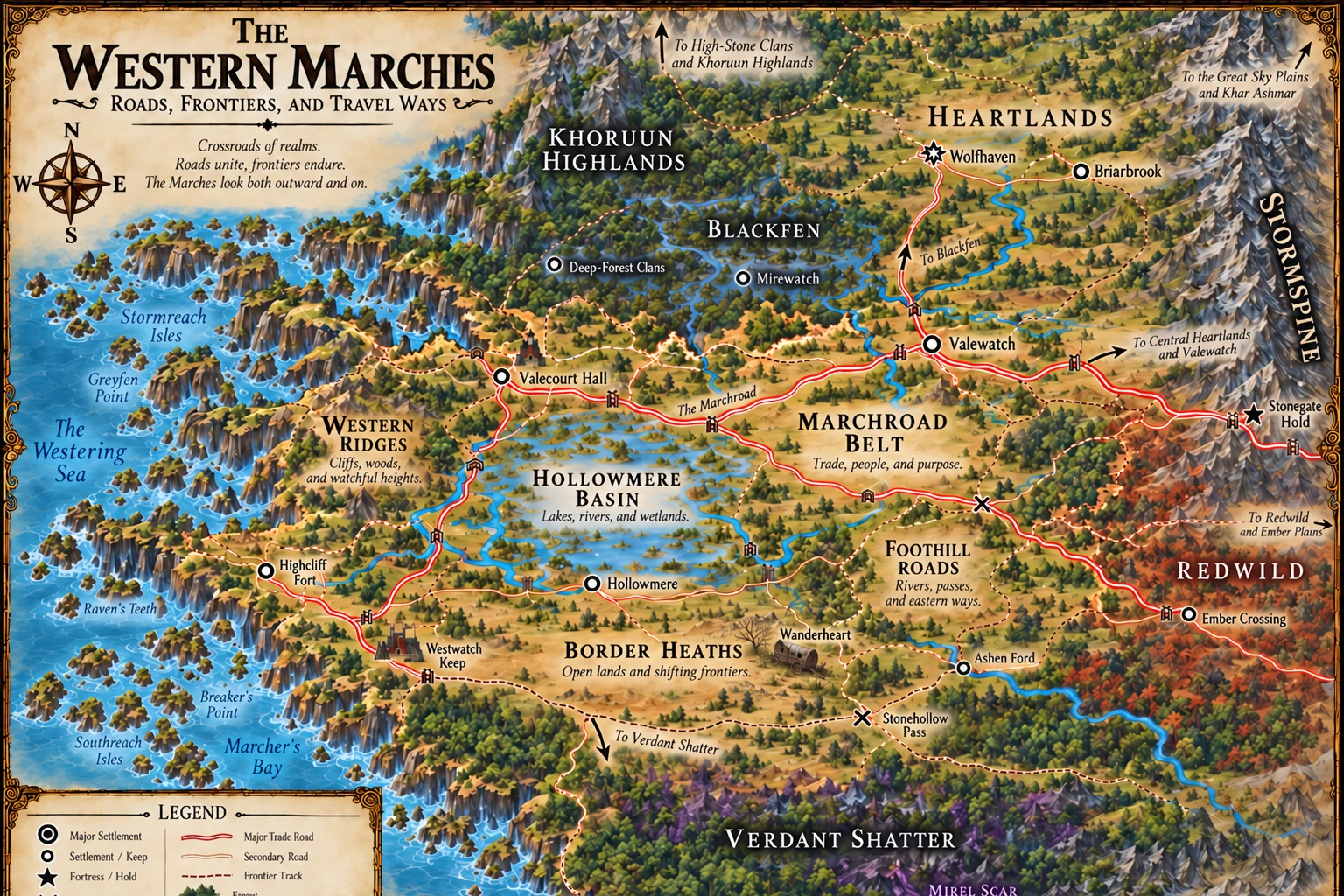
Five kinds of road country
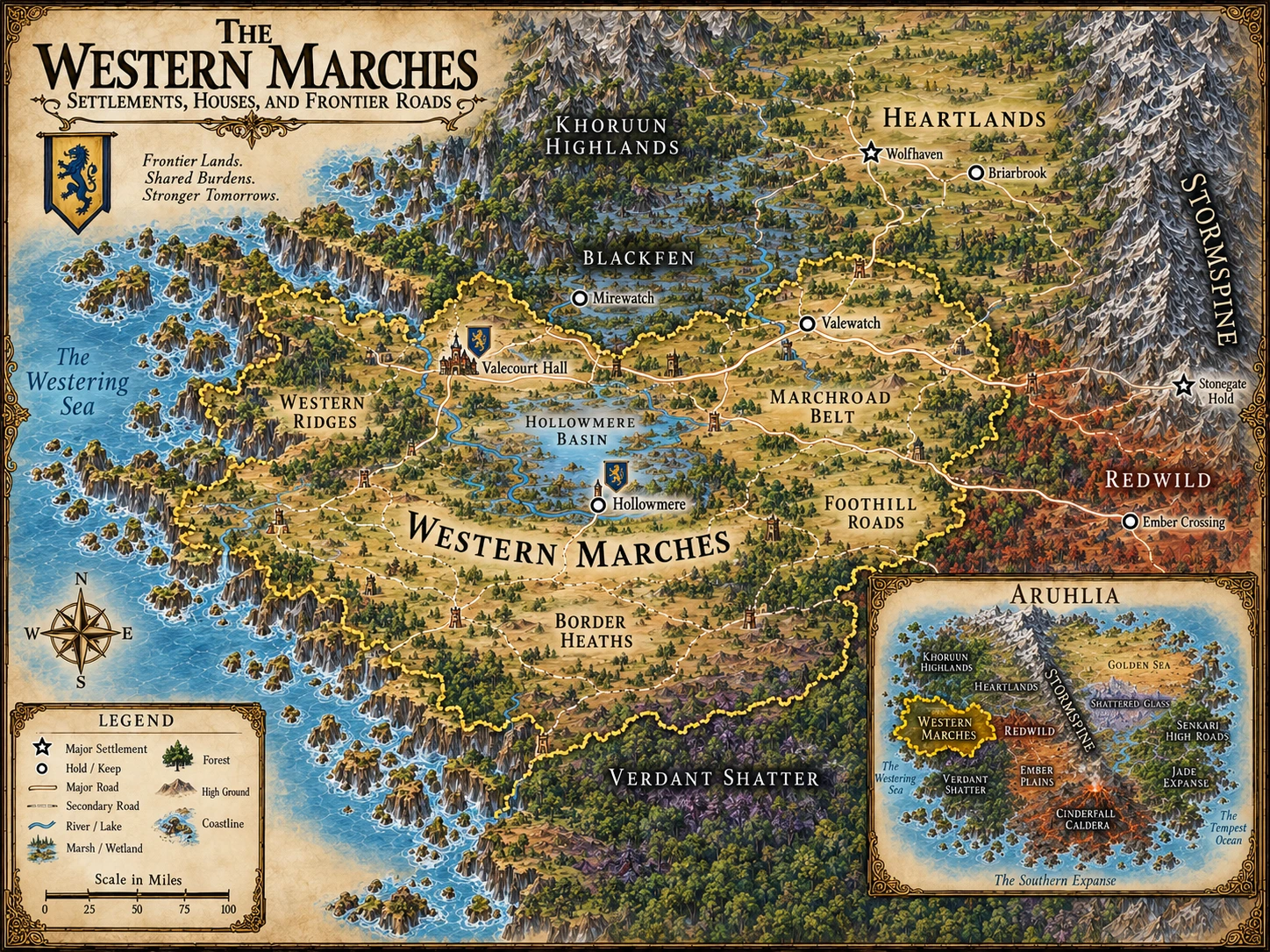
The Marchroad Belt carries the busiest east–west traffic. Hollowmere Basin gathers riders and wagons around converging roads; the Western Ridges slow travel through broken uplands. Beyond them lie the Border Heaths and the northern Foothill Roads.
 Location
Marchroad Belt
The busiest east–west road corridor, with inns, smithies, stables, caravan yards, healers, wardwrights, patrol stations and market settlements.
 Location
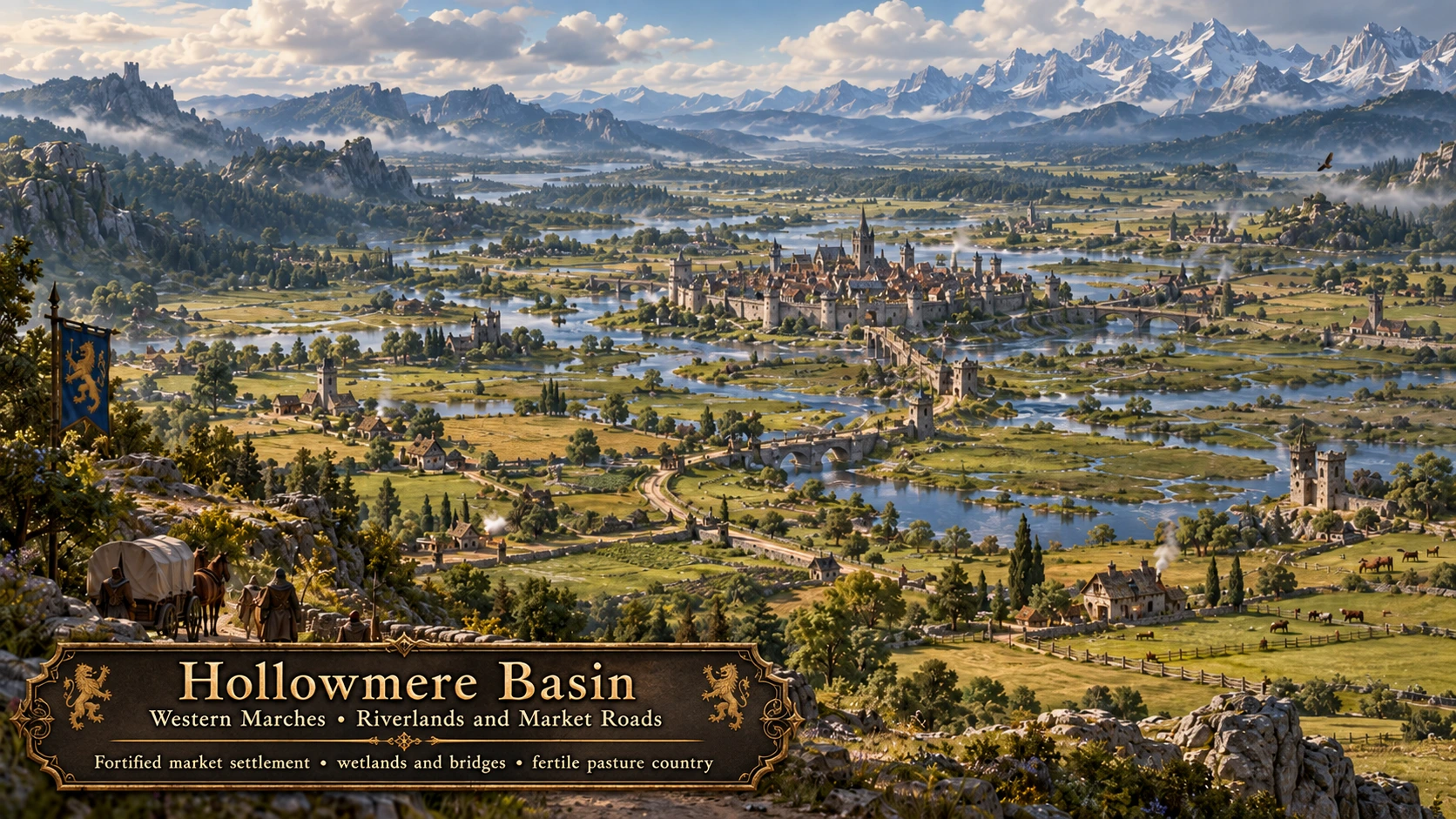
Hollowmere Basin
The settled basin around Hollowmere brings together watercourses, pasture, farmland and converging roads. It is a major seasonal gathering ground for wagons and riders.
 Location
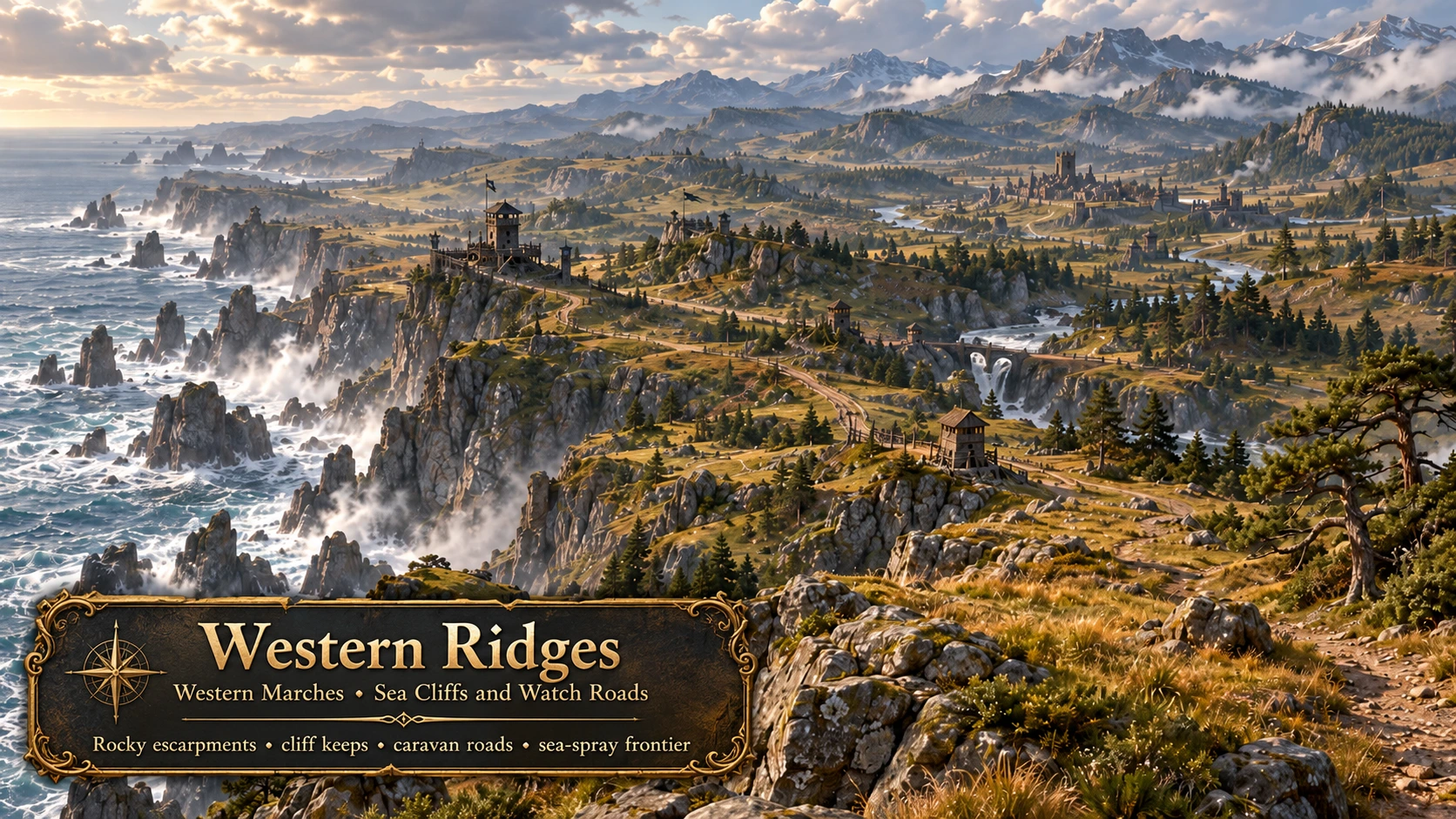
Western Ridges
Broken uplands, wooded slopes, quarry roads, watch stations and narrow defensible crossings. Local service holdings maintain stretches of road.
 Location
Border Heaths
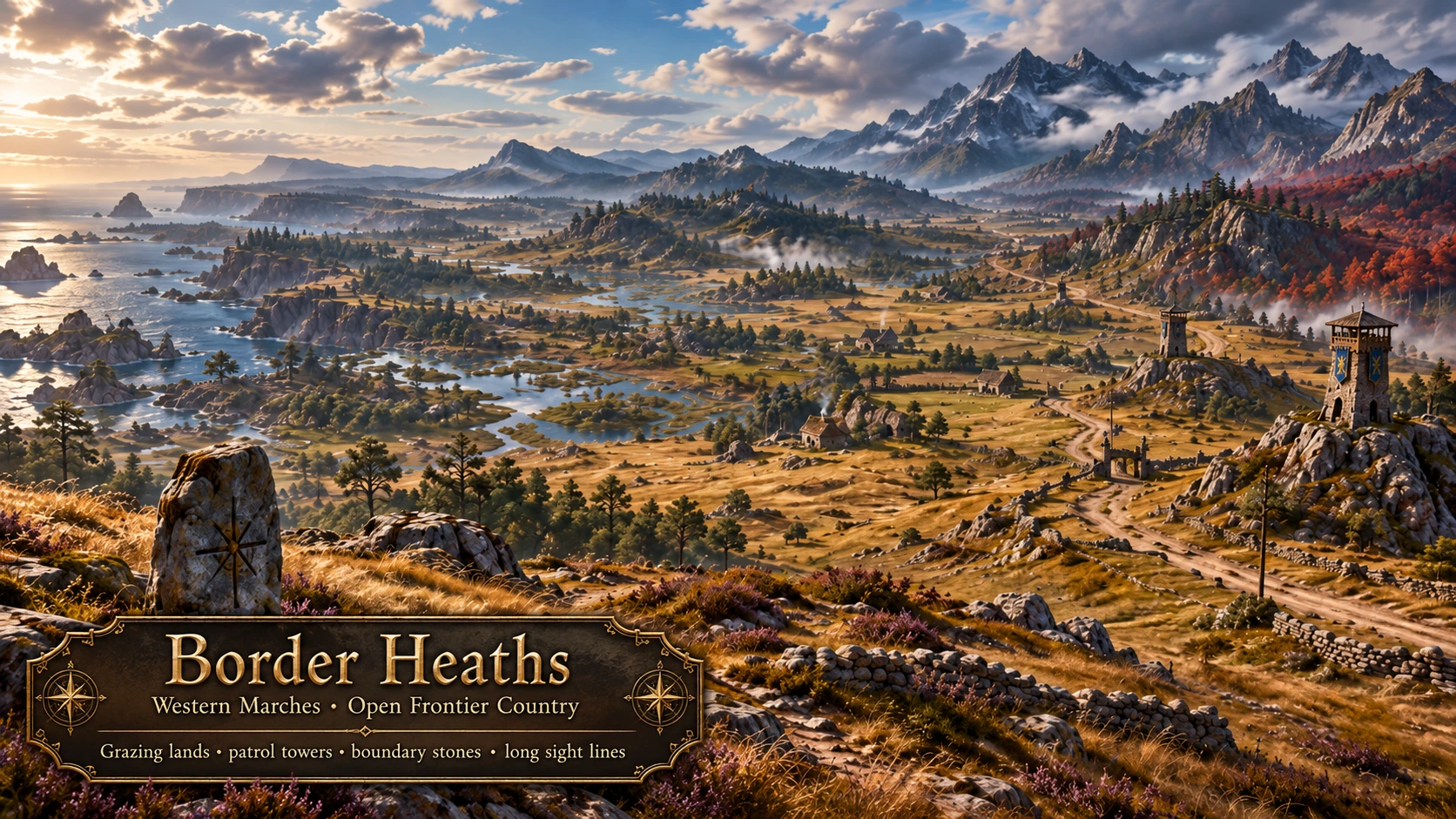
Exposed western country with scattered farms, grazing camps, patrol towers, old boundary stones and long sight lines. Hardened caravan guards serve mobile camps.
LocationFoothill Roads
Northern approach roads carry merchants, quarry trains, patrols and pilgrims toward Stormspine and the Khoruun Highlands. Heavy draft animals serve specialized mountain wagons.
 Location
Valecourt Hall
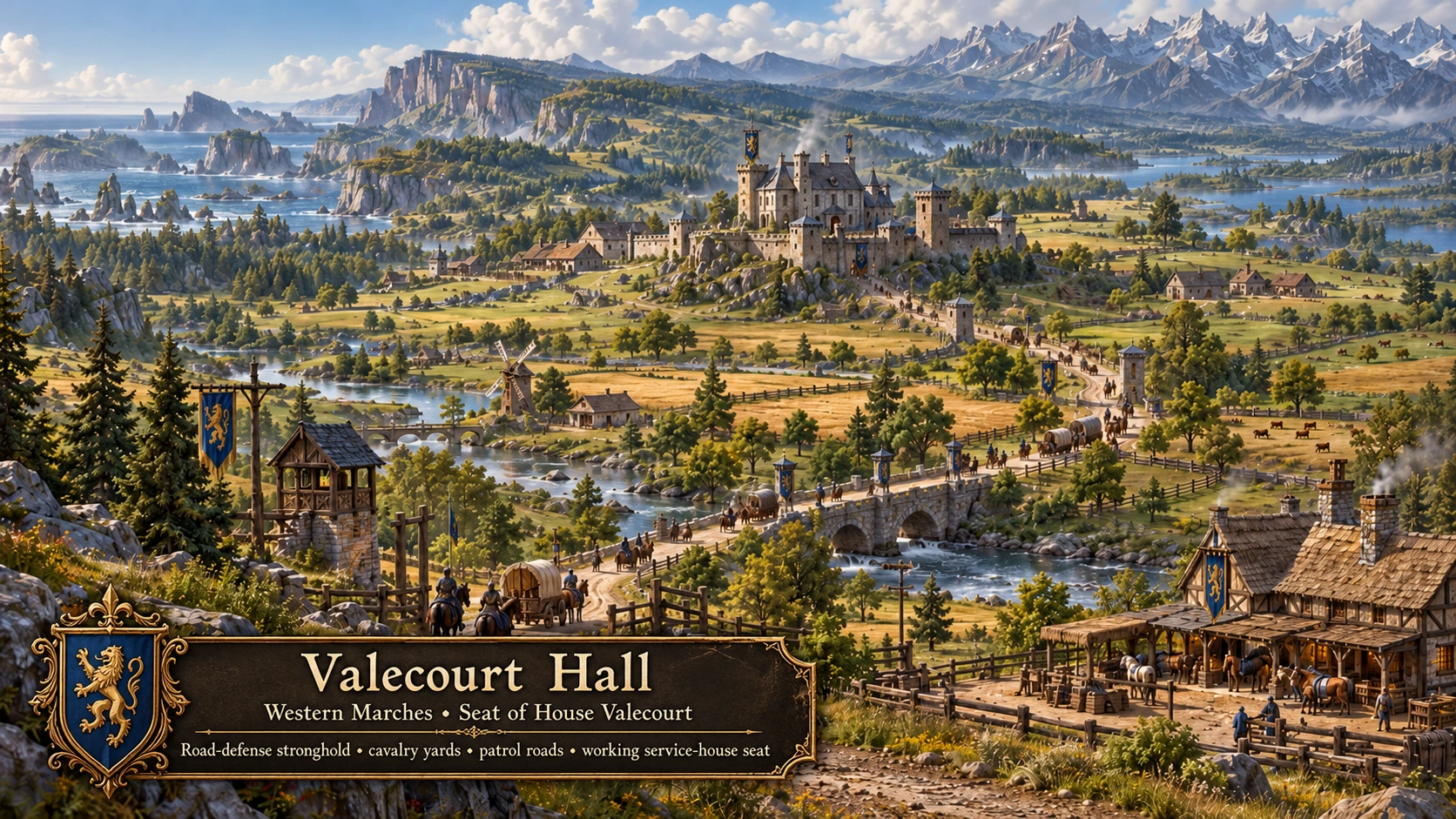
Working seat of House Valecourt: cavalry yards, stables, armories, planning rooms, repair spaces and dispatch functions support road defense.
SettlementHollowmere
A fortified road-and-market settlement and Valecourt-connected defensive holding in the Hollowmere Basin. Gates, garrison and converging routes give it strategic importance.
Service, family and the Gold Lion
House Valecourt is a Crested service house, led by Marshal Helena Valecourt from Valecourt Hall. Road defense, cavalry, escort work, armoring and contract honor define its role. Its family heraldry is permanently the Gold Lion on Deep Blue; it does not own the Western Marches.
 House
HouseHouse Valecourt
A respected Crested House of the Western Marches known for road defense, cavalry, escort work, armoring, and contract honor.
 Character
Marshal Helena Valecourt
House Leader of Valecourt and a campaign-ready commander of the Western Marches roads.
CharacterLivia Valecourt
The Lioness of House Valecourt, whose family Gold Lion and later company identity belong to different stages of her story.
Roads are a civic institution
Patrol circuits, escort contracts, bridge wards, messenger relays, shelters, caravan yards and repair notices make travel possible. Ward-lamps, signal crystals and enchanted tools are ordinary high-magic infrastructure. They still need maintenance.
Living wagons can be homes, workshops, kitchens, clinics, shrines or defensive shelters. Families grow, graft, repair and enchant the same wagon across generations. Riders range ahead as scouts, couriers, outriders, herd guards and monster spotters.
Guest-fire customs, road marriages, route-rights, mount fairs, races and rider coming-of-age journeys form a shared culture. “Marcher” is a regional identity, not a race.
Read prices in Copper Leaves, Silver Fangs, Gold Sovereigns and Platinum HowlsWho does that Strider road with?
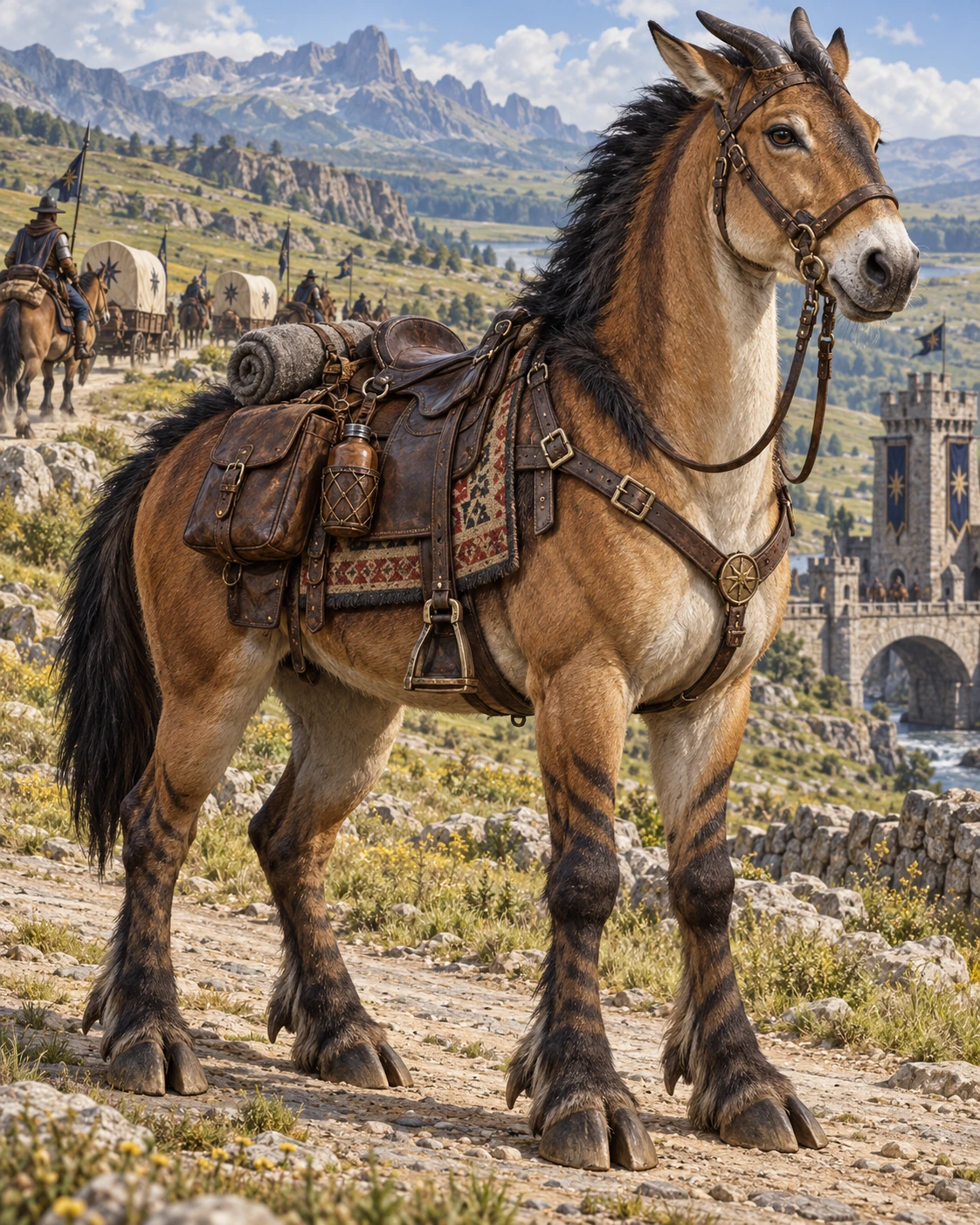
Marchstriders are endurance mounts with crown horns, split hooves and Groundsense: a weak natural sensitivity to disturbances through earth and stone. The warning knock is three beats: THUD. THUD. THUD. It can warn of unstable ground and buried Roadmaws.
Road-bonding begins with care, walking and progressively longer journeys. The first successful full-day ride is the First Road. An ordinary horse is the modest-budget choice; specialized Marchstriders usually belong to well-funded riders, companies, couriers, patrols or Houses.
 Animal
Marchstrider
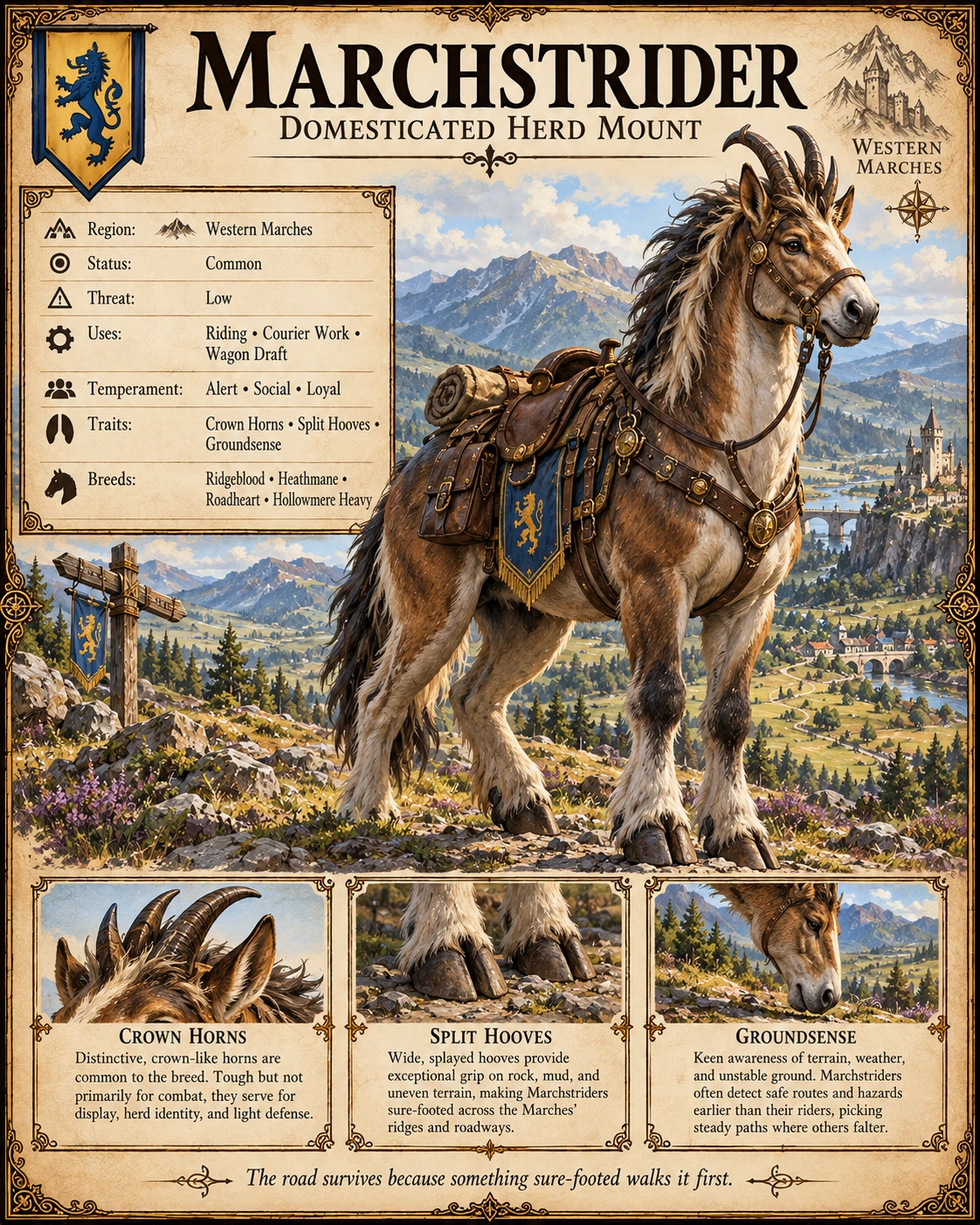
Fully domesticated herd mount for riding, courier work and wagon draft. Alert, social and loyal, with crown horns, split hooves and Groundsense. Its three-beat warning knock signals danger underfoot.
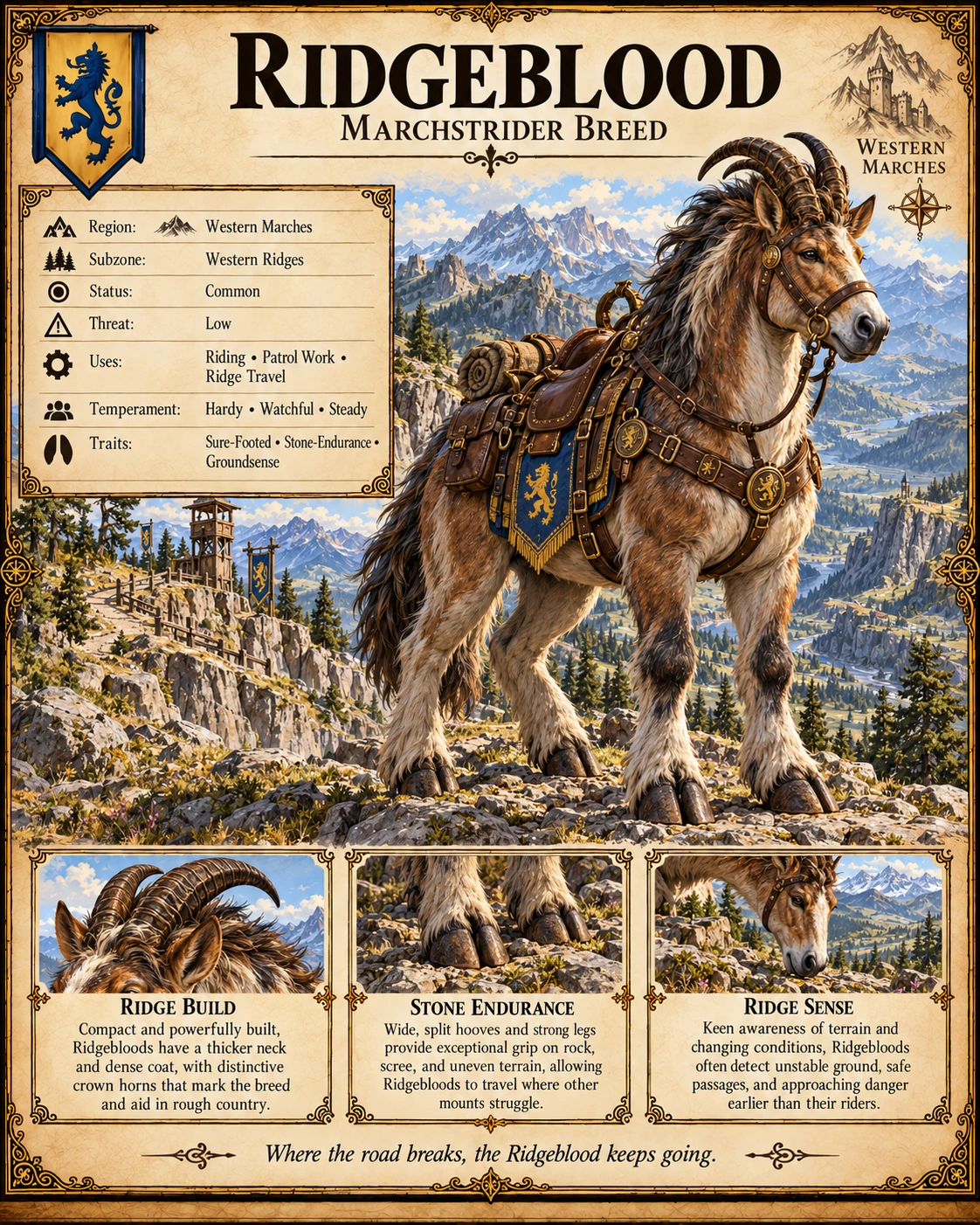 Animal
Ridgeblood Marchstrider
Tall, narrow, exceptionally sure-footed; favored by ridge scouts and messengers.
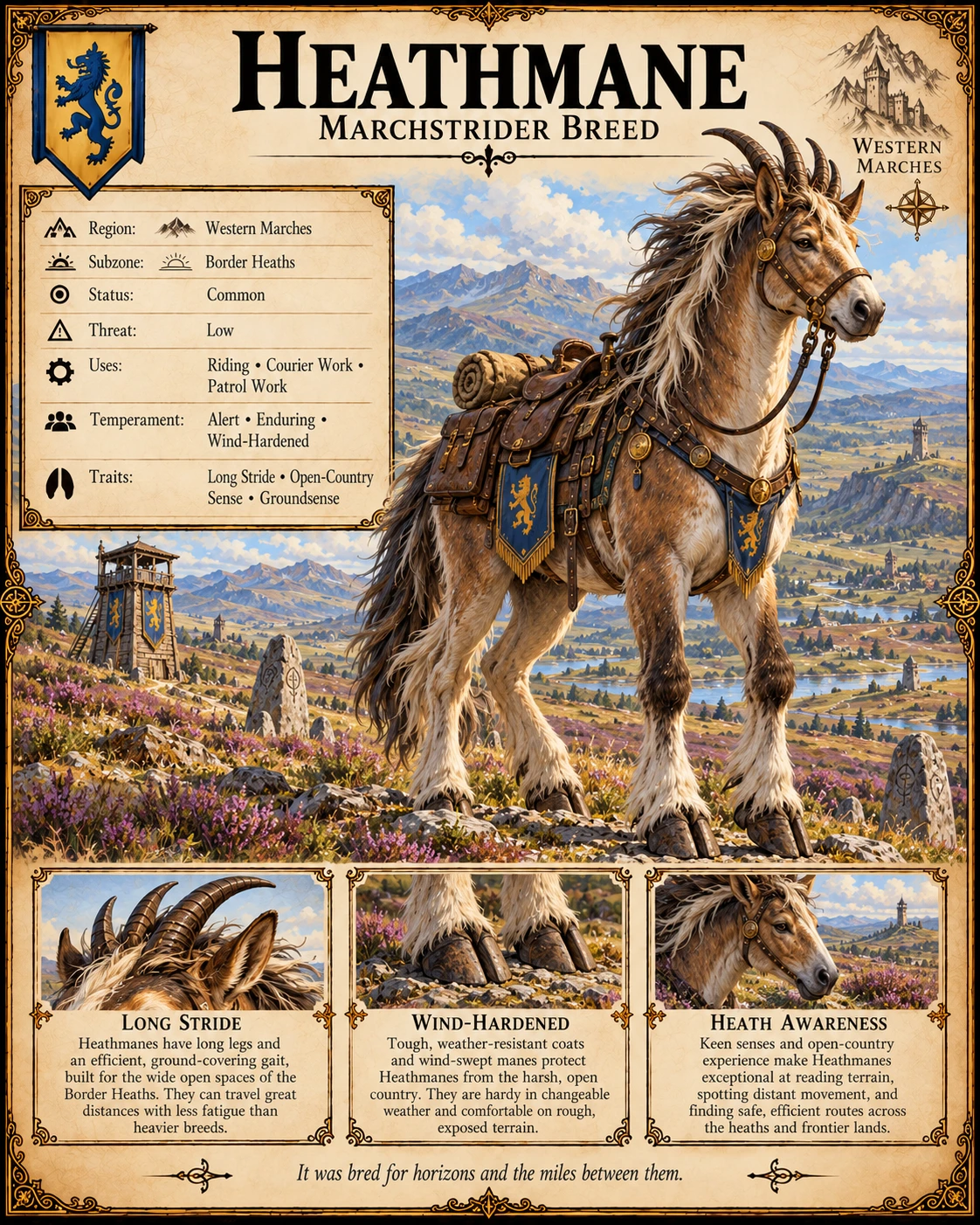 Animal
Heathmane Marchstrider
Shaggy, hardy and closest to wild stock. Aggressive toward predators and capable of surviving poor grazing.
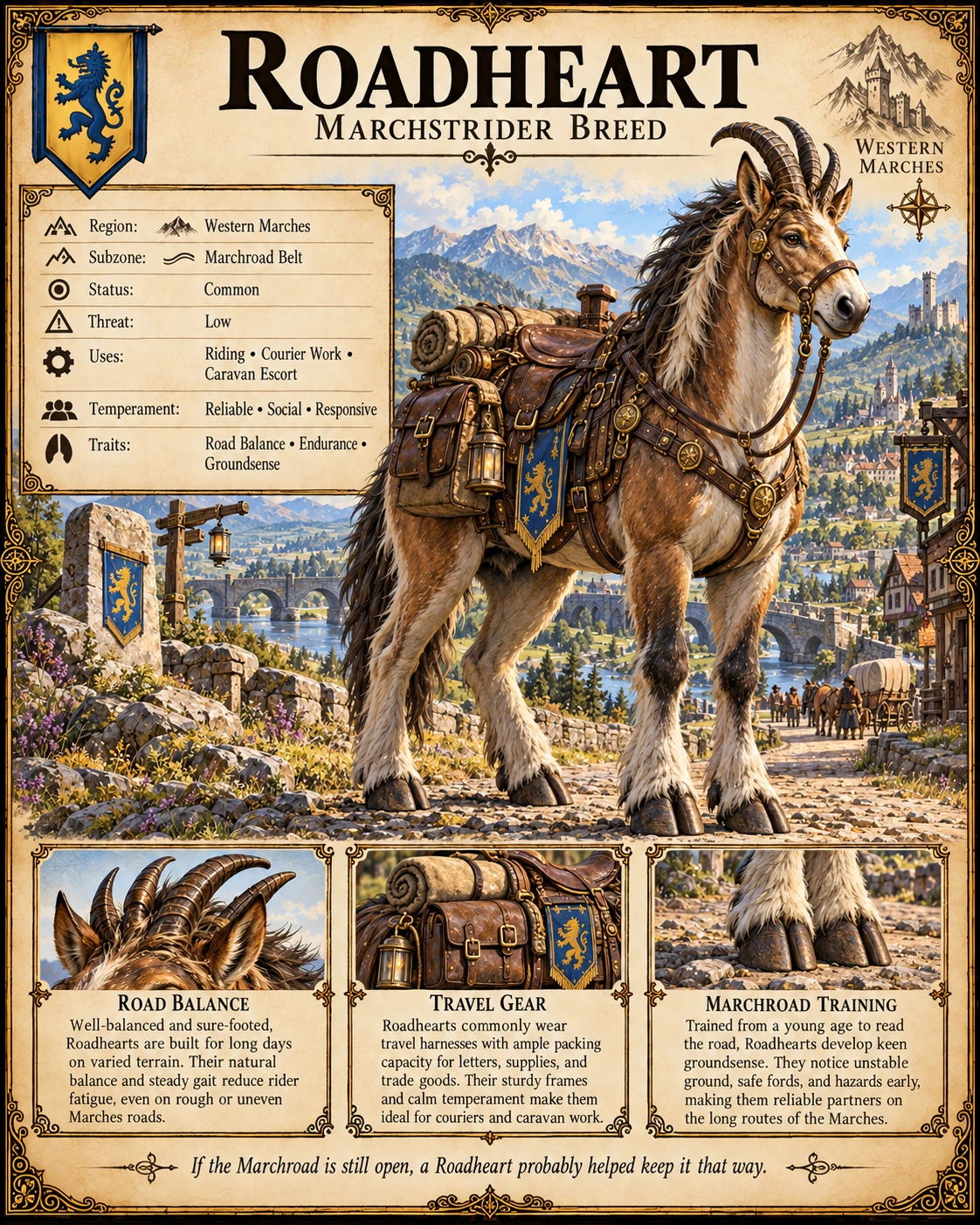 Animal
Roadheart Marchstrider
Calm, broad-backed, intelligent classic riding strain of the Marchroad Belt.
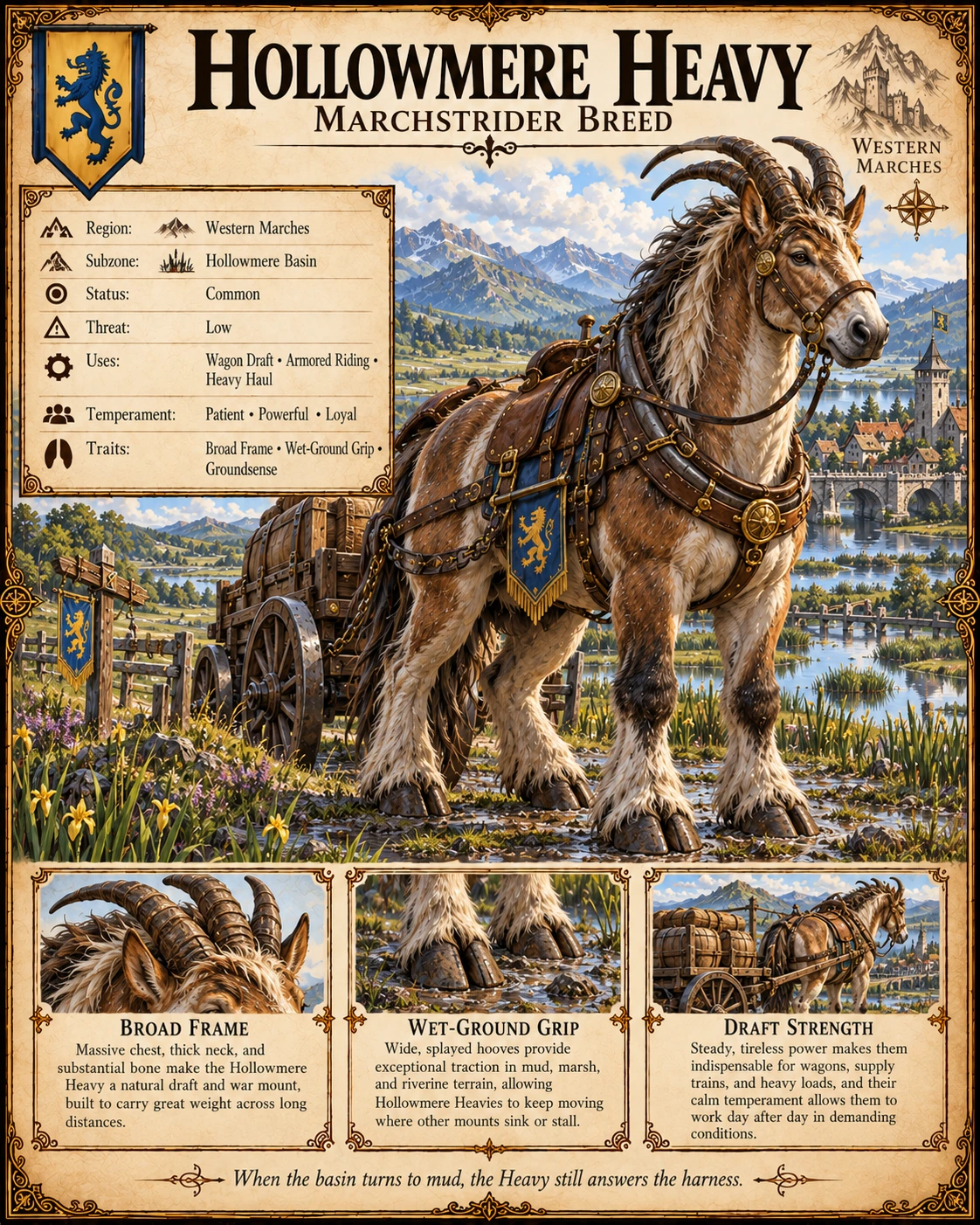 Animal
Hollowmere Heavy Marchstrider
Massive draft strain used with living wagons; slower than riding breeds but exceptionally powerful.
Tracking Info
Split-hoof prints are broad and unusually even, with shallow paired horn-scrapes where animals lower their heads to investigate unstable ground. Herd routes show repeated three-beat hoof dents near buried hazards. Droppings often contain Goldmane Grass and Waybread Clover seed.
Deeper Ethology
Marchstriders are intensely social and read the movement of neighboring herd members before reacting to danger. Their Groundsense is strongest while standing still or walking slowly; experienced riders learn that sudden refusal, synchronized ear-turning, and the three-beat warning knock are information, not stubbornness. Young animals imitate adult route choices and can learn the location of bad bridges, unstable shoulders, and habitual Roadmaw ground. Working lines bond strongly to routine, team position, and familiar handlers. Panic spreads quickly through an untrained herd, while veteran wagon teams often freeze and orient together before bolting.
When This Is Wrong
A break from these patterns is a reason to investigate. Injury, hunger, breeding, severe weather, migration, displacement, disease, mana instability or learned responses to people can change behavior. Observe the context before deciding what the sign means.
Read the land before the encounter
Animal → Mana Beast → Monster. Threat grades describe encounter danger, not Guild rank, loot rarity or automatic hostility. The Marches teach adventuring through roads, weather, tracking and roaming creatures; dungeon delving is only one part of that work.
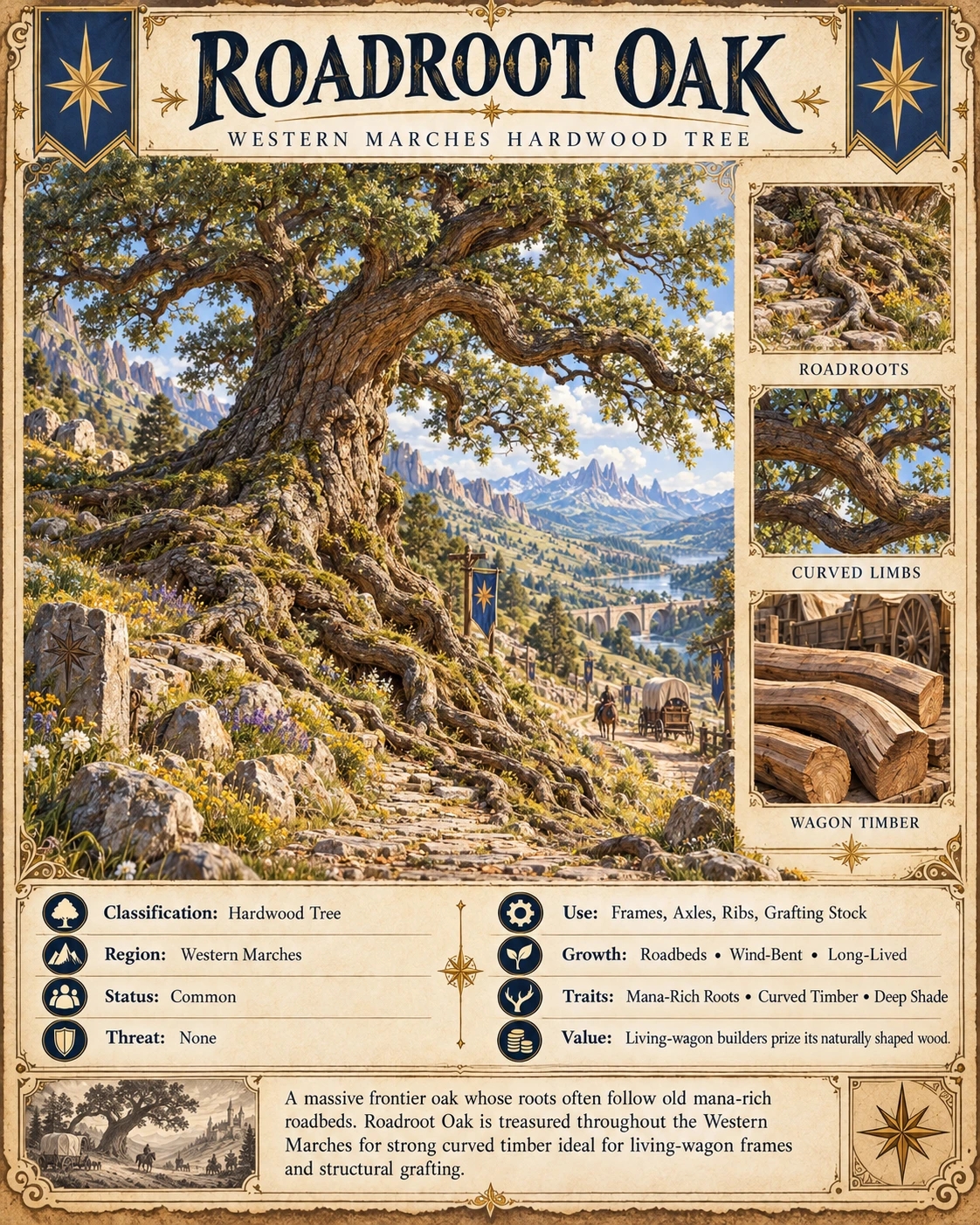 Flora
FloraRoadroot Oak
Wind-bent hardwood whose roots often follow old mana-rich roadbeds. Living-wagon builders prize naturally curved limbs for frames, axles, ribs, and grafting stock.
Enlarge approved card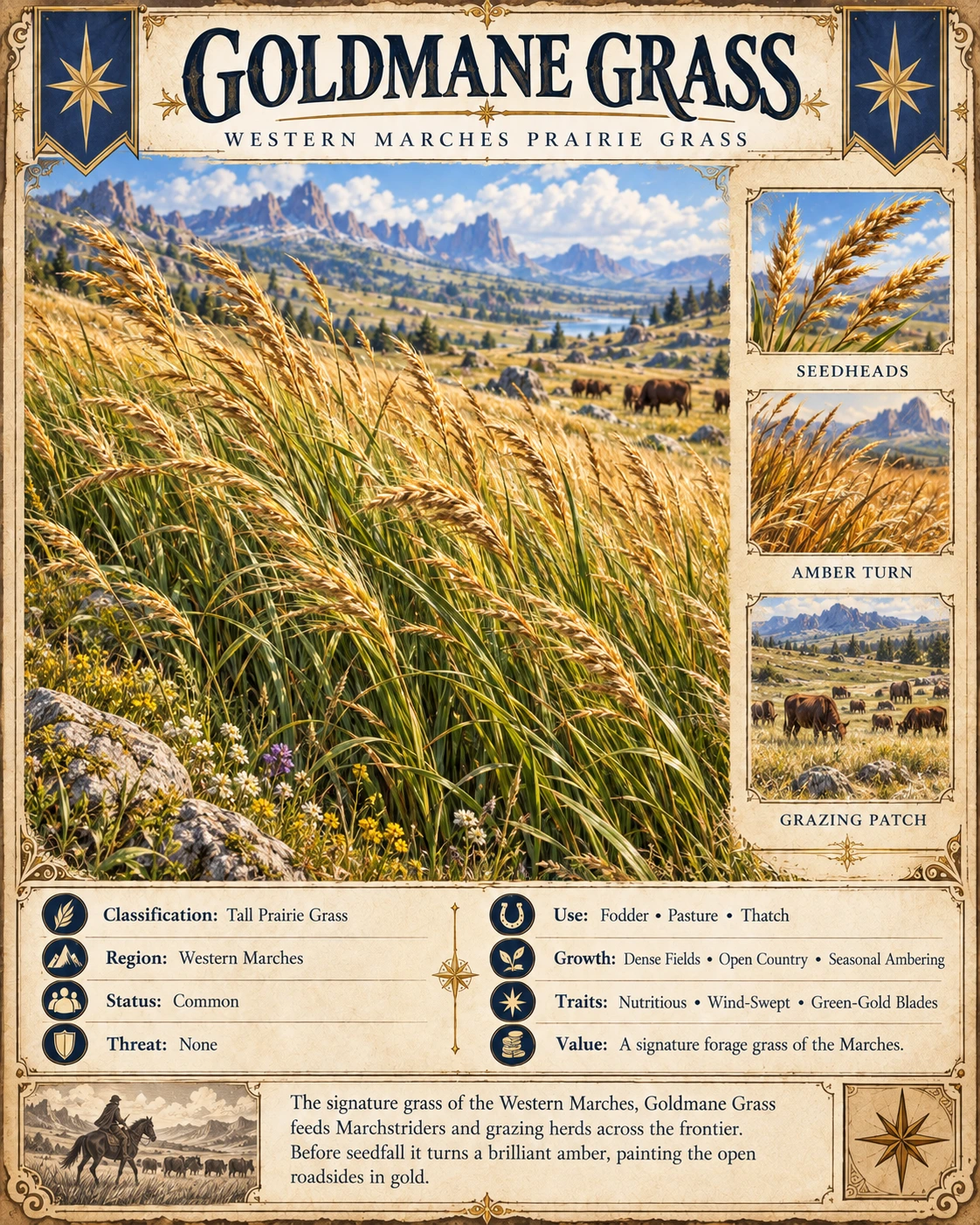 Flora
FloraGoldmane Grass
Signature green-gold prairie grass; highly nutritious for Marchstriders and herd animals; turns brilliant amber before seedfall.
Enlarge approved card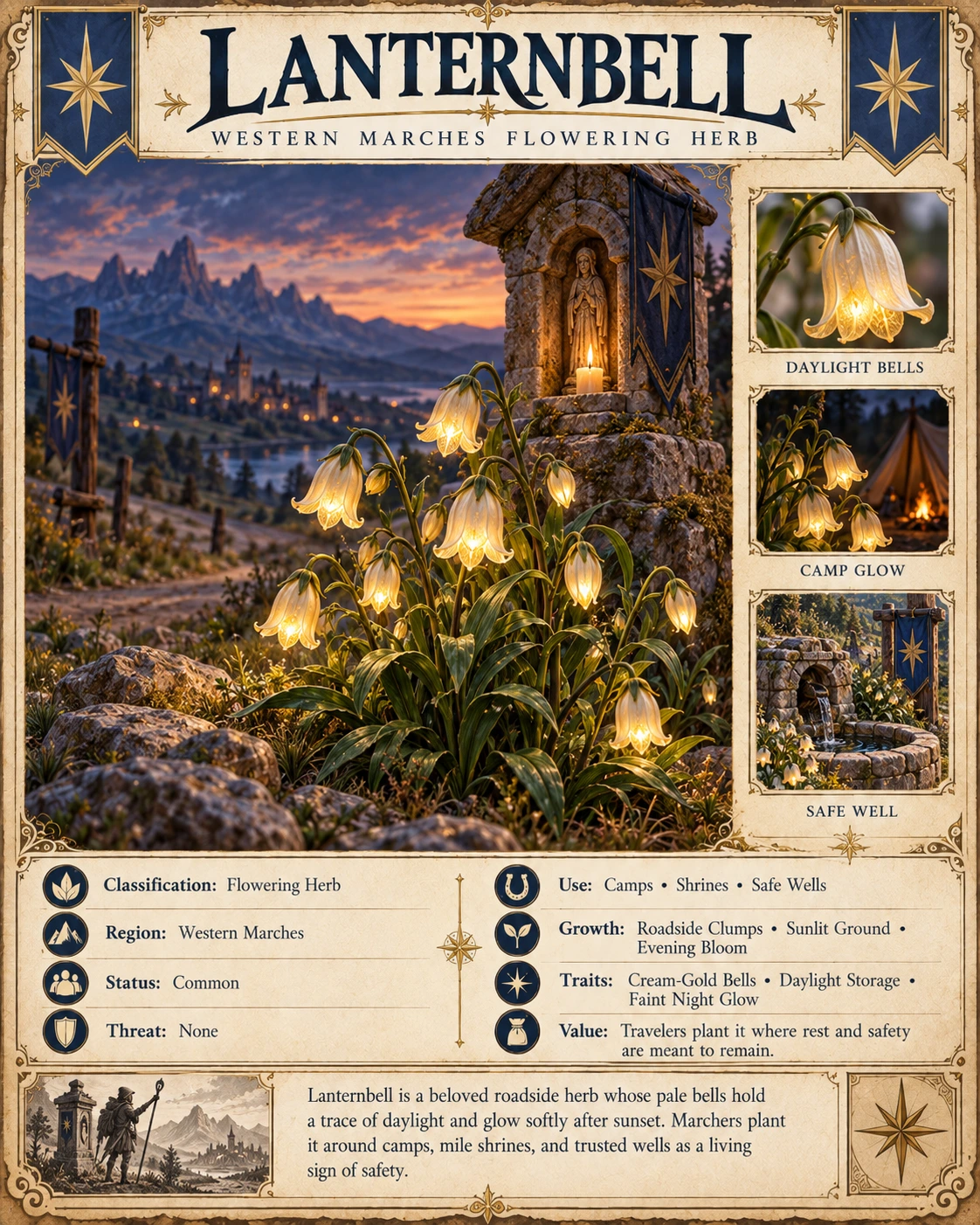 Flora
FloraLanternbell
Cream-and-gold flowering herb that stores daylight and glows faintly after sunset; planted around camps, mile shrines, and safe wells.
Enlarge approved card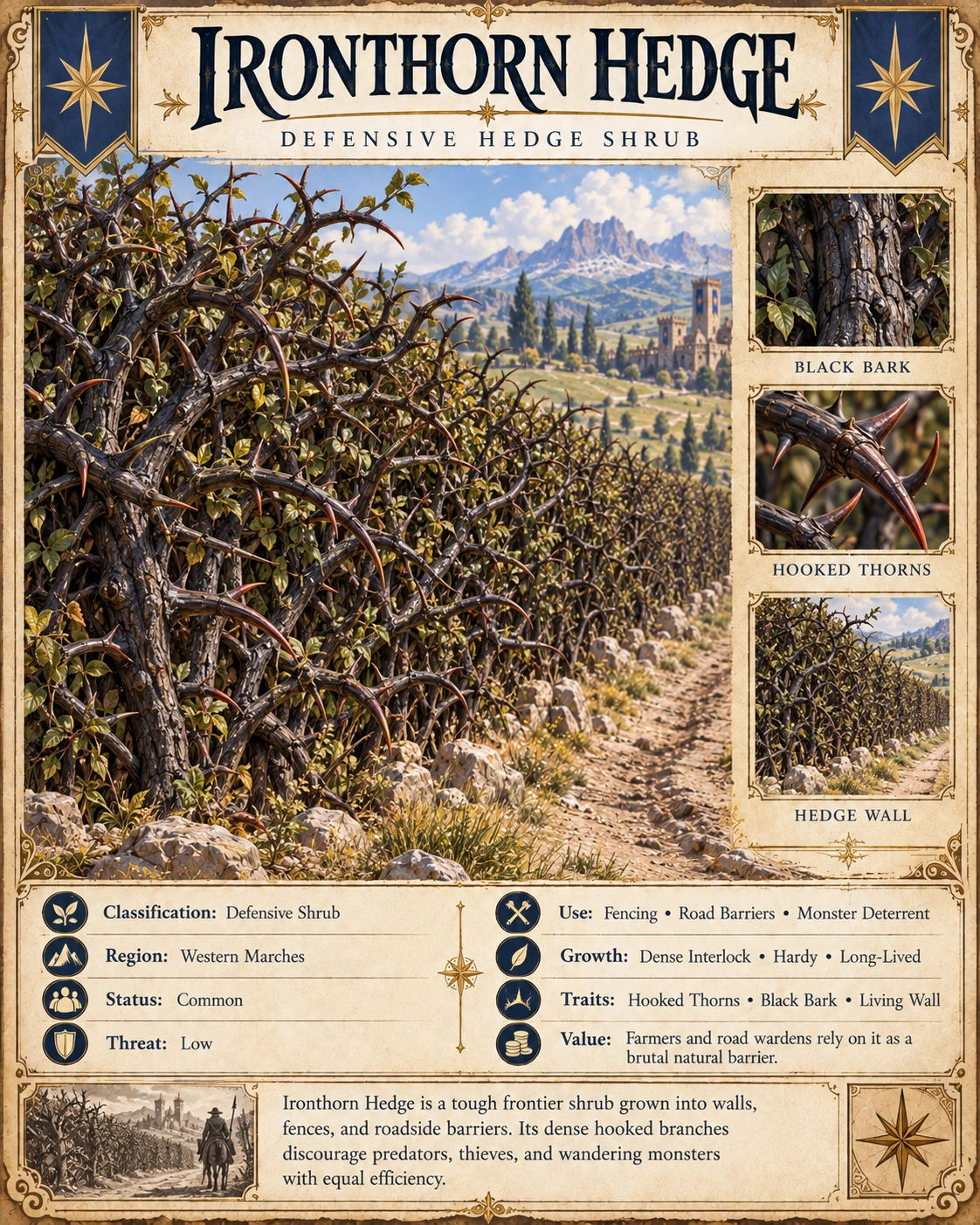 Flora
FloraIronthorn Hedge
Dense black-barked defensive shrub with hooked thorns; used as living fencing and monster deterrent.
Enlarge approved card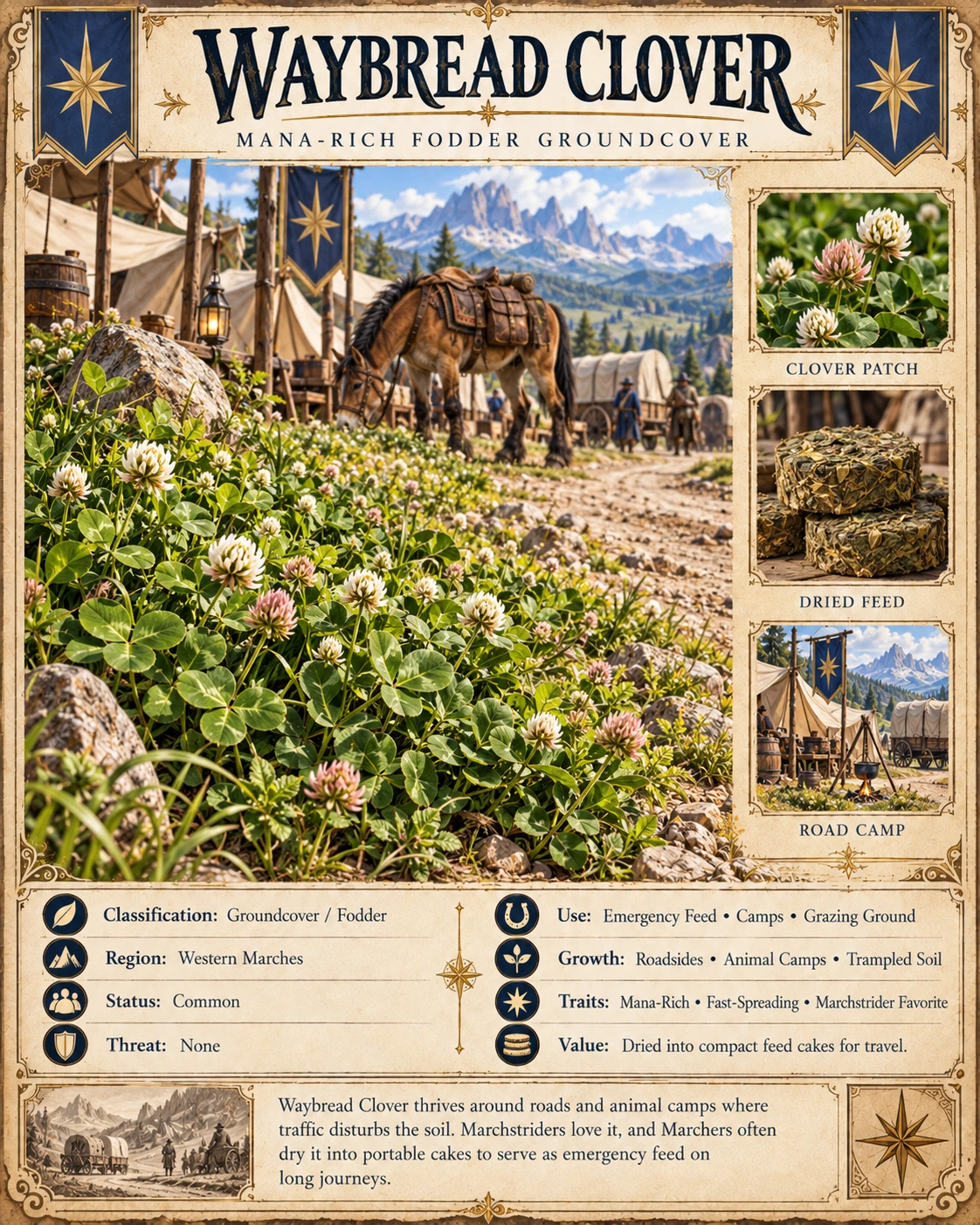 Flora
FloraWaybread Clover
Mana-rich road and camp fodder favored by Marchstriders; dried into emergency mount-feed cakes.
Enlarge approved card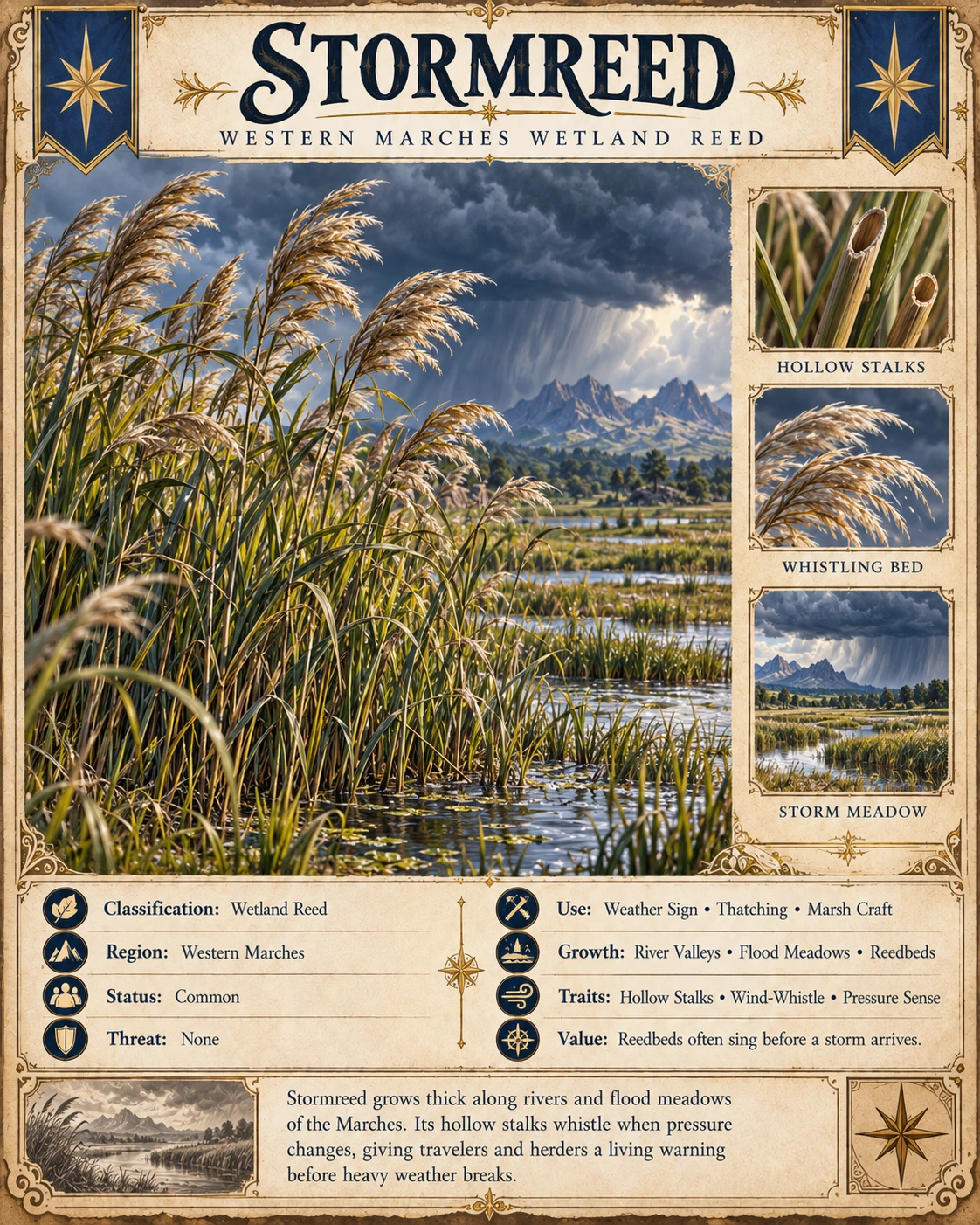 Flora
FloraStormreed
Wetland reed whose hollow stalks whistle before pressure changes and major storms.
Enlarge approved card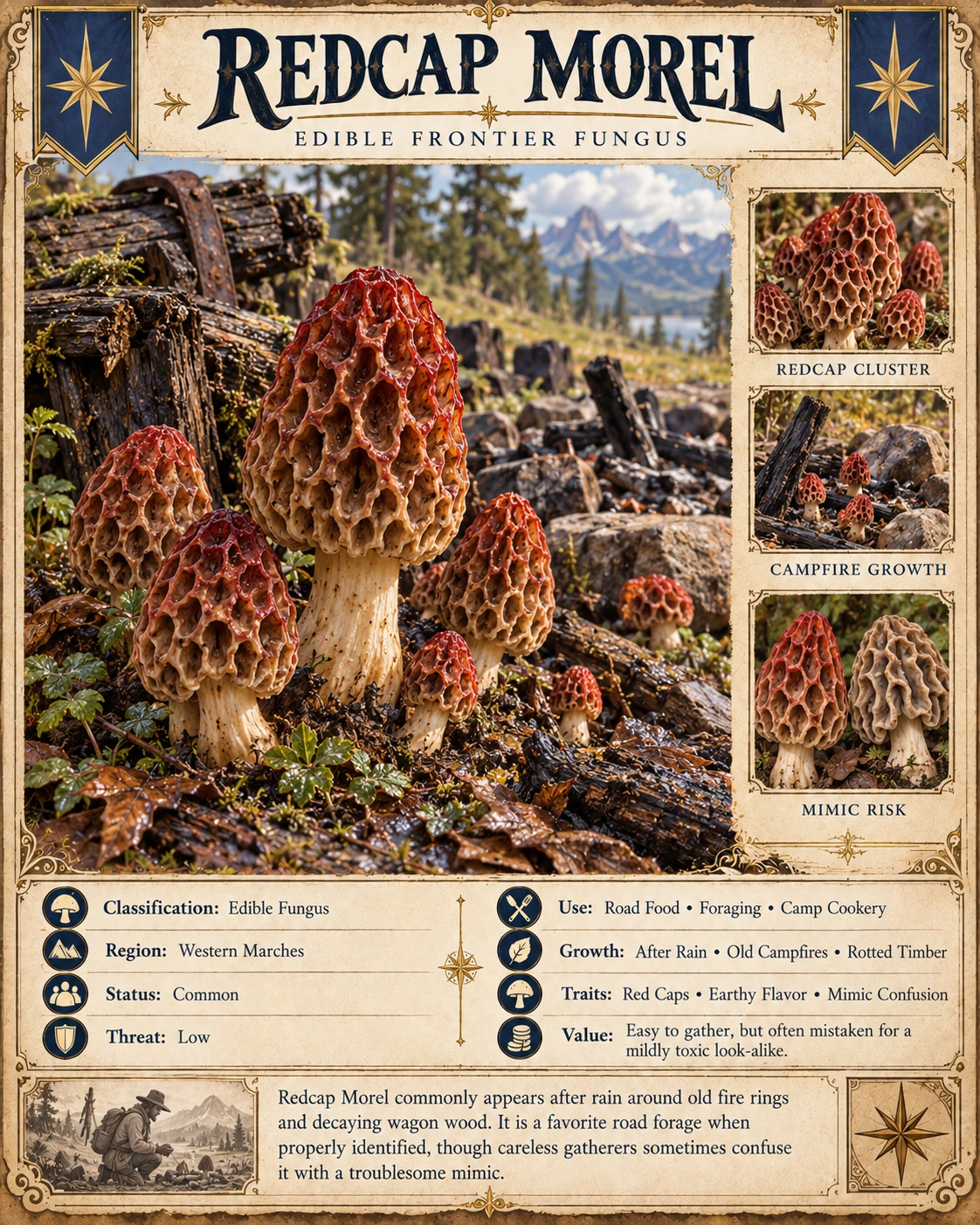 Flora
FloraRedcap Morel
Edible fungus appearing around old campfires and rotted wagon timber after rainfall; has a mildly toxic mimic.
Enlarge approved card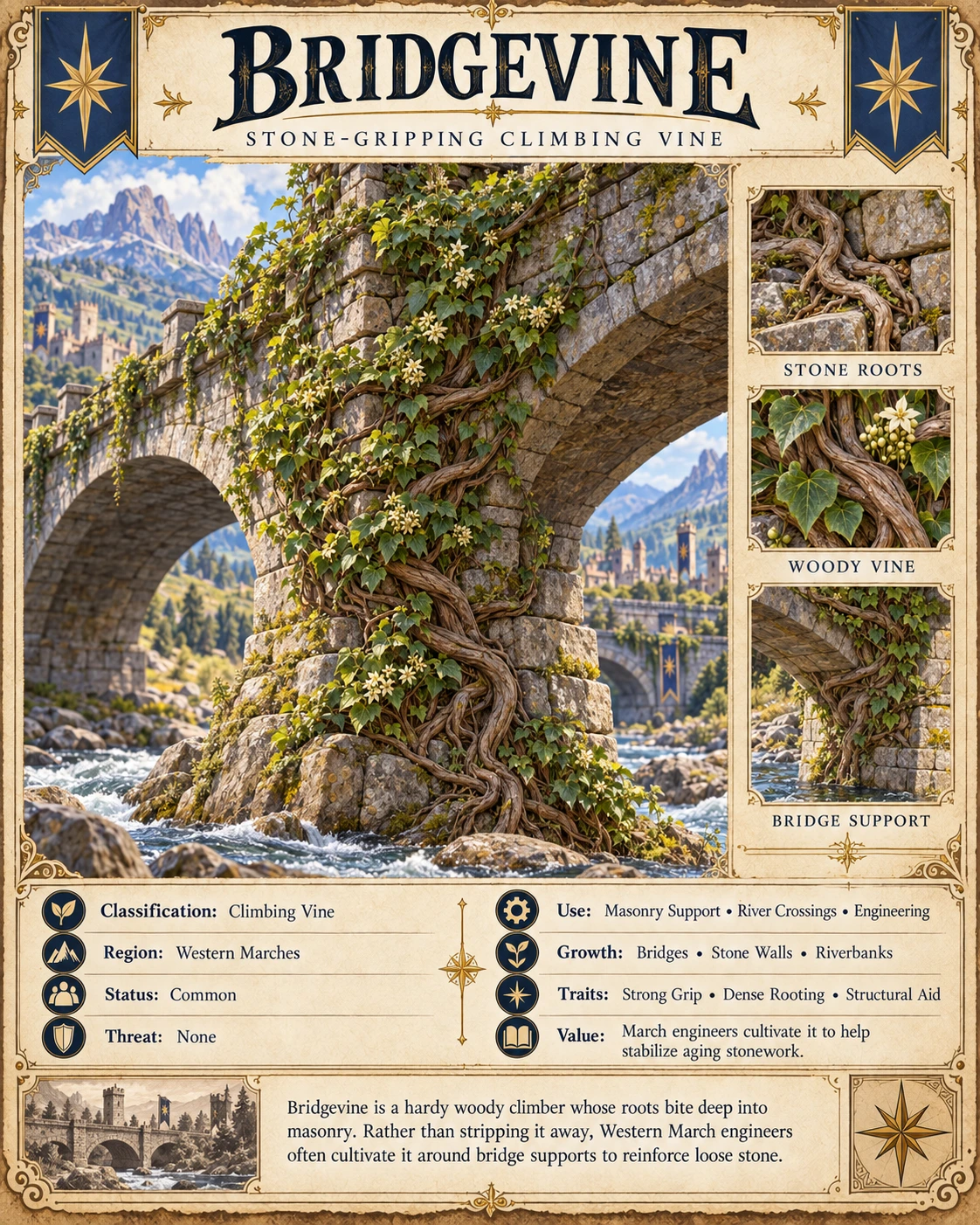 Flora
FloraBridgevine
Tough woody climber that grips masonry; cultivated around bridge supports to help stabilize loose stone.
Enlarge approved card Animal
Bannerwing Kite
Large long-tailed raptor; riders read its behavior for weather and carrion.
Enlarge approved cardTracking Info & Deeper Ethology
Tracking Info
Large hooked footprints appear on ridge perches, with long-tail drag marks on narrow roosts. Fresh carrion is often preceded by several Kites circling at different heights rather than one tight spiral. Their feathers snag on windward thorn and fence posts.
Deeper Ethology
Bannerwing Kites spend most daylight hours riding wind rather than flapping. They track weather fronts, herd movement, and carrion from extreme distance. Riders learn that a sudden drop from high soaring to low restless circles usually means worsening pressure, violent wind, or a large ground disturbance. Pairs defend nesting ledges but tolerate loose feeding congregations. They are cautious around living prey larger than a hare and rarely descend into active combat unless defending young.
When This Is Wrong
A break from these patterns is a reason to investigate. Injury, hunger, breeding, severe weather, migration, displacement, disease, mana instability or learned responses to people can change behavior. Observe the context before deciding what the sign means.
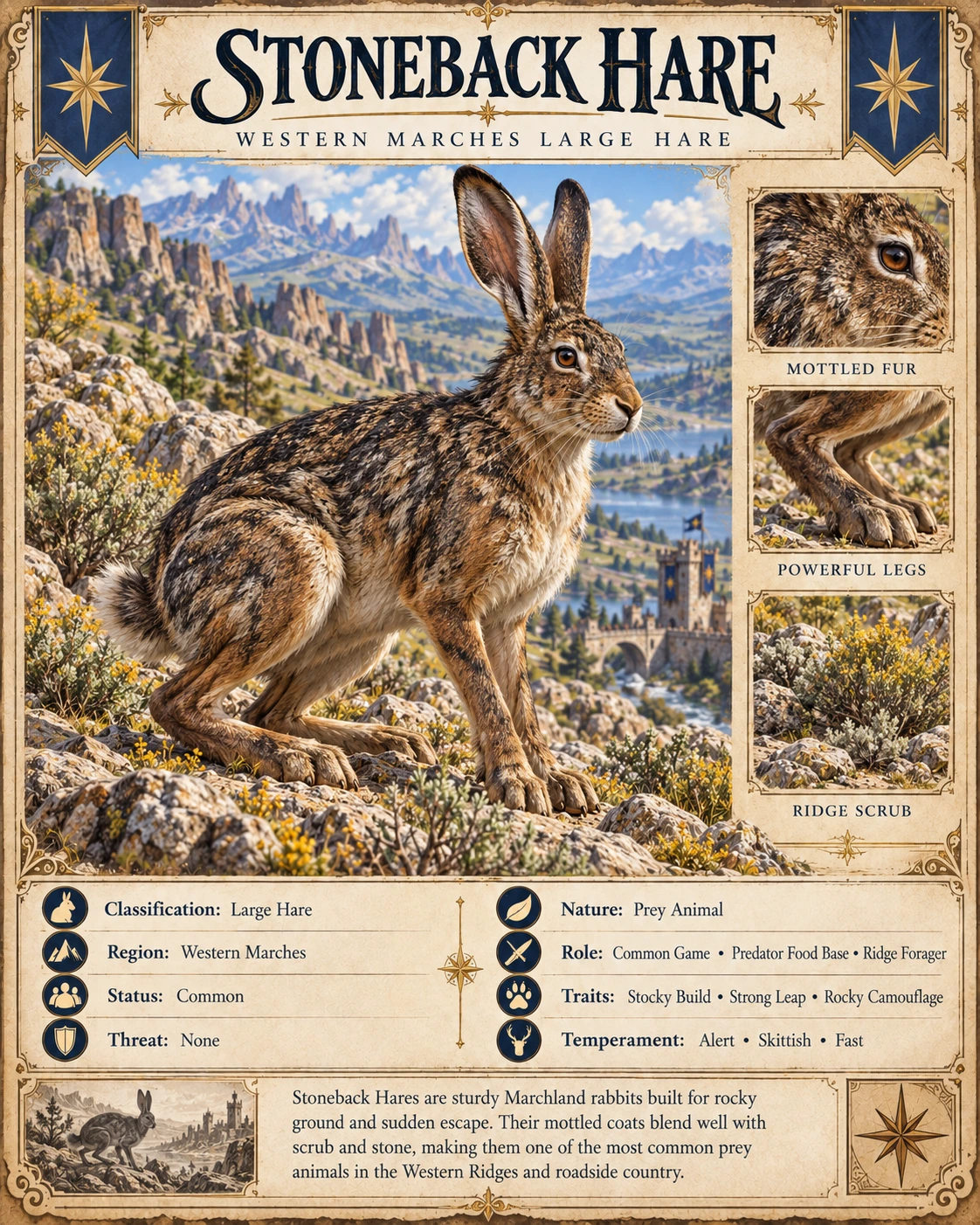 Animal
Stoneback Hare
Stocky dark-mottled hare with powerful legs; common prey in ridges and roadside scrub.
Enlarge approved cardTracking Info & Deeper Ethology
Tracking Info
Hind prints are deep and widely spaced even at slow speed. Resting forms look like shallow oval bowls beneath scrub. Gnawed stems are clipped at a steep angle, and escape runs often zigzag toward rock rather than open grass.
Deeper Ethology
Stoneback Hares freeze longer than ordinary rabbits because their mottled bodies blend with loose stone. They rely on explosive acceleration only after a threat passes a personal distance threshold. Mothers use several shallow day-rests instead of one permanent nest. In hard weather they gather loosely near sun-warmed rock. A landscape with abundant hare sign but no fresh resting forms often means a predator has recently begun working the area.
When This Is Wrong
A break from these patterns is a reason to investigate. Injury, hunger, breeding, severe weather, migration, displacement, disease, mana instability or learned responses to people can change behavior. Observe the context before deciding what the sign means.
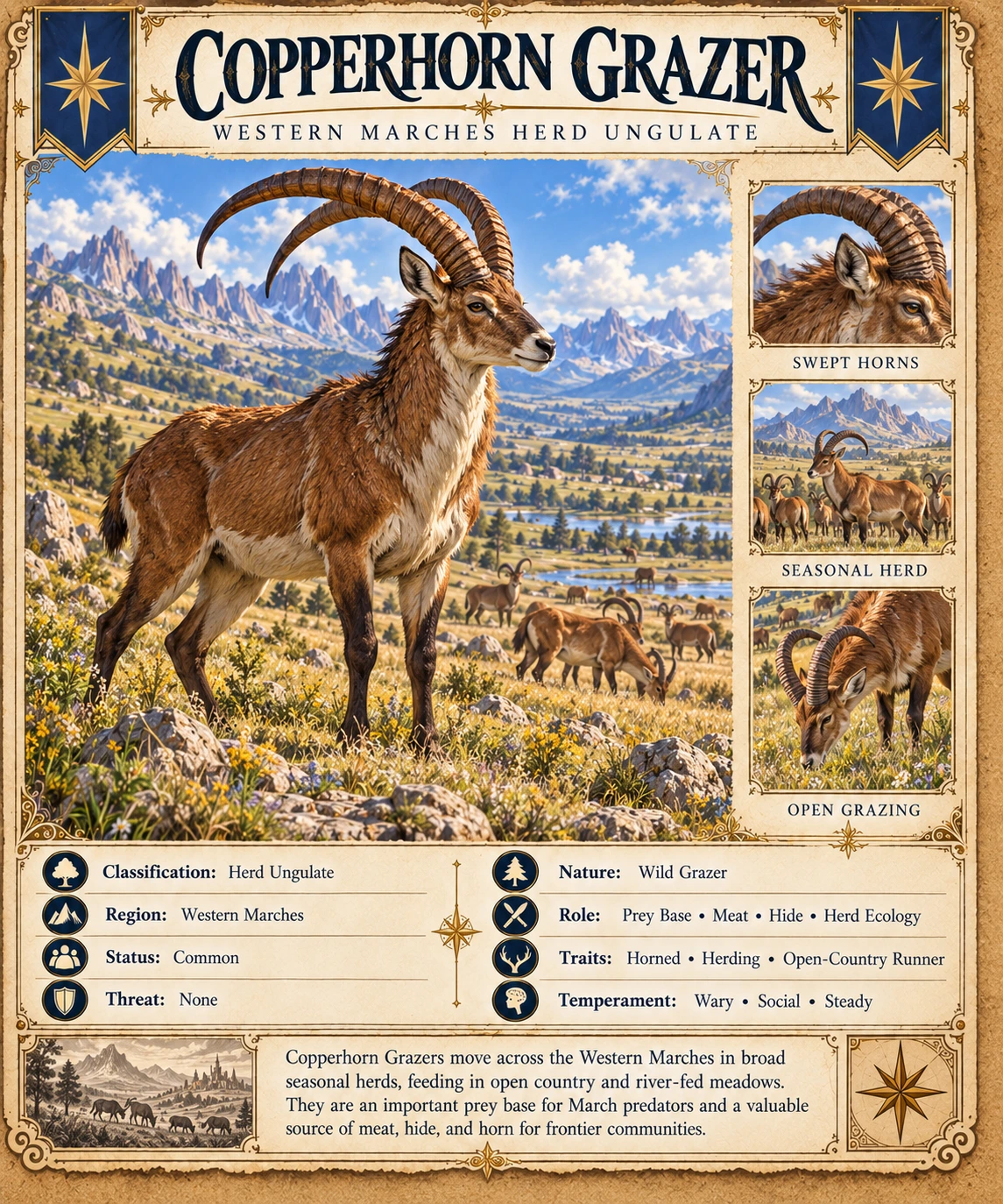 Animal
Copperhorn Grazer
Medium-sized horned herd grazer moving in large seasonal herds; major prey base.
Enlarge approved cardTracking Info & Deeper Ethology
Tracking Info
Herd trails are wide, parallel, and polished into grassland. Horn-rub trees show copper-colored scoring and stripped bark shoulder-high. Seasonal bedding grounds flatten Goldmane Grass in overlapping crescents.
Deeper Ethology
Copperhorns move in large seasonal herds and use older animals as route memory. Herds compress around calves in open country and stretch into lines through narrow roads or ridges. Bulls become less tolerant during rut but most charges begin with lateral display, hoof-scuffing, and horn presentation. Predators often shadow the rear third of moving herds, so experienced riders watch both the grazers and the scavengers that trail them.
When This Is Wrong
A break from these patterns is a reason to investigate. Injury, hunger, breeding, severe weather, migration, displacement, disease, mana instability or learned responses to people can change behavior. Observe the context before deciding what the sign means.
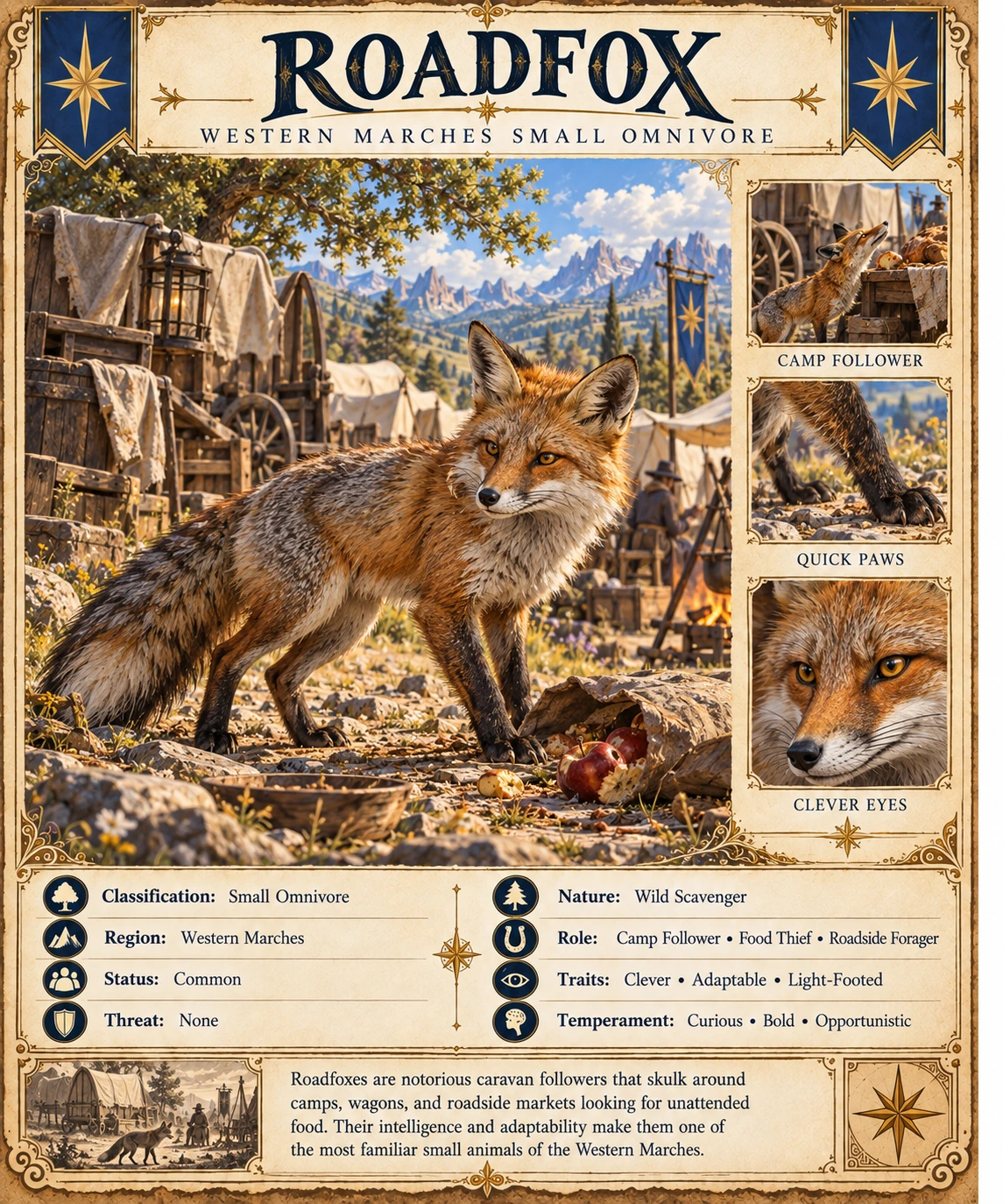 Animal
Roadfox
Clever reddish-gray caravan follower and food thief; some become semi-tame camp followers.
Enlarge approved cardTracking Info & Deeper Ethology
Tracking Info
Small canine tracks parallel roads rather than crossing them directly. Camps frequently show one missing food item with minimal disturbance. Scat is often placed conspicuously on mile stones, wagon ruts, or abandoned hearth edges.
Deeper Ethology
Roadfoxes are opportunistic camp followers that learn caravan schedules, cookfire routines, and which travelers throw scraps. Individuals living along busy roads become far bolder than isolated foxes and may shadow the same wagon company for days. They test unattended objects, retreat when directly watched, and often circle back from downwind. Semi-tame animals still retain independent denning and foraging behavior. A Roadfox that abandons a profitable road abruptly may be reacting to a larger predator.
When This Is Wrong
A break from these patterns is a reason to investigate. Injury, hunger, breeding, severe weather, migration, displacement, disease, mana instability or learned responses to people can change behavior. Observe the context before deciding what the sign means.
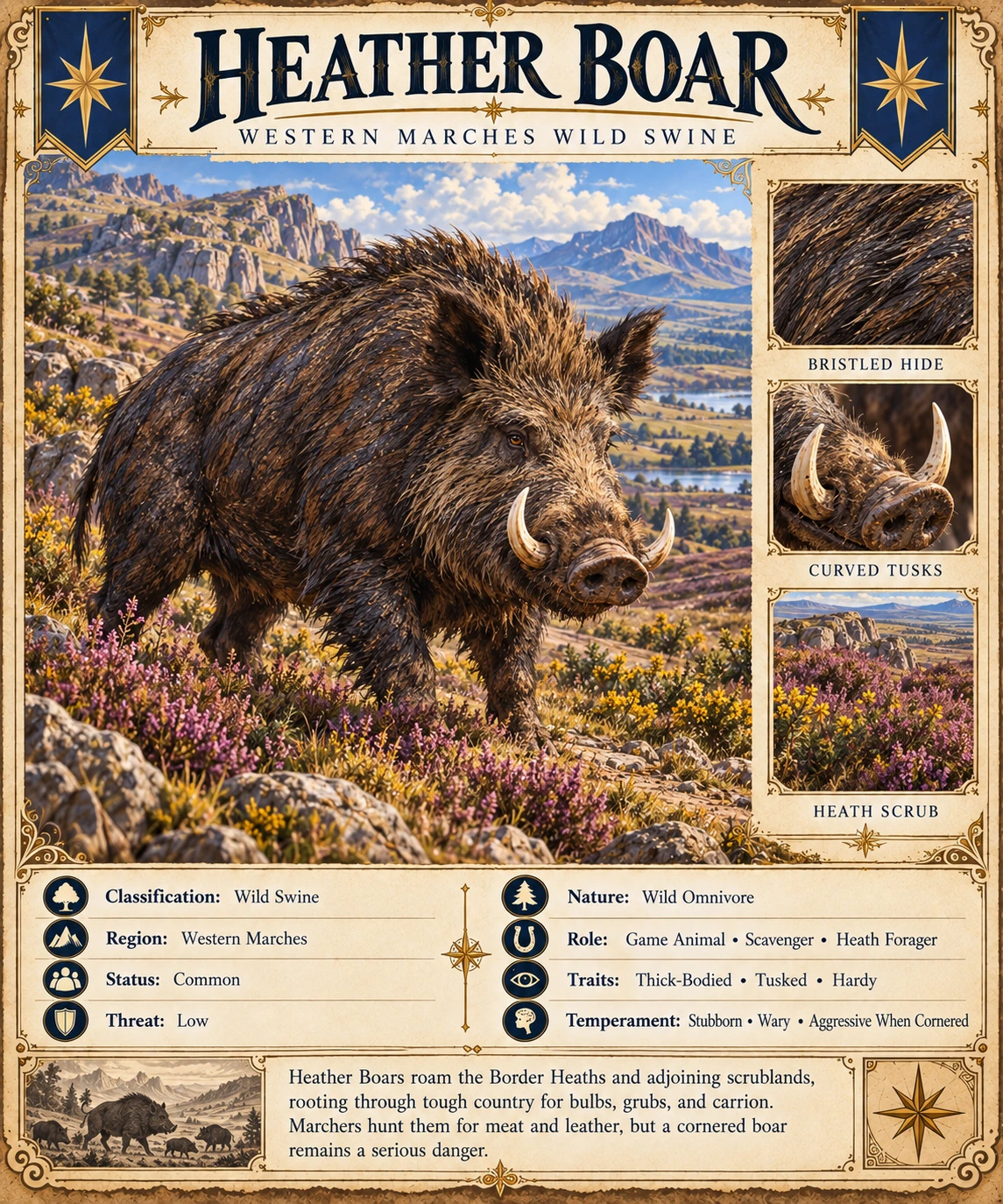 Animal
Heather Boar
Thick-bodied Border Heaths omnivore; dangerous when cornered; hunted for meat and leather.
Enlarge approved cardTracking Info & Deeper Ethology
Tracking Info
Rooted soil is turned in broad, shallow fans rather than neat holes. Tusks polish Ironthorn and low tree trunks. Mud wallows carry strong musk and coarse dark bristles.
Deeper Ethology
Heather Boars are omnivorous and usually prefer avoidance, but they commit hard when cornered, wounded, or defending piglets. Family groups are matriarchal; mature males are more solitary outside breeding periods. They feed heavily after rain when roots and invertebrates rise near the surface. Veteran hunters look for fresh rooting direction because animals often bed downwind of the last feeding patch.
When This Is Wrong
A break from these patterns is a reason to investigate. Injury, hunger, breeding, severe weather, migration, displacement, disease, mana instability or learned responses to people can change behavior. Observe the context before deciding what the sign means.
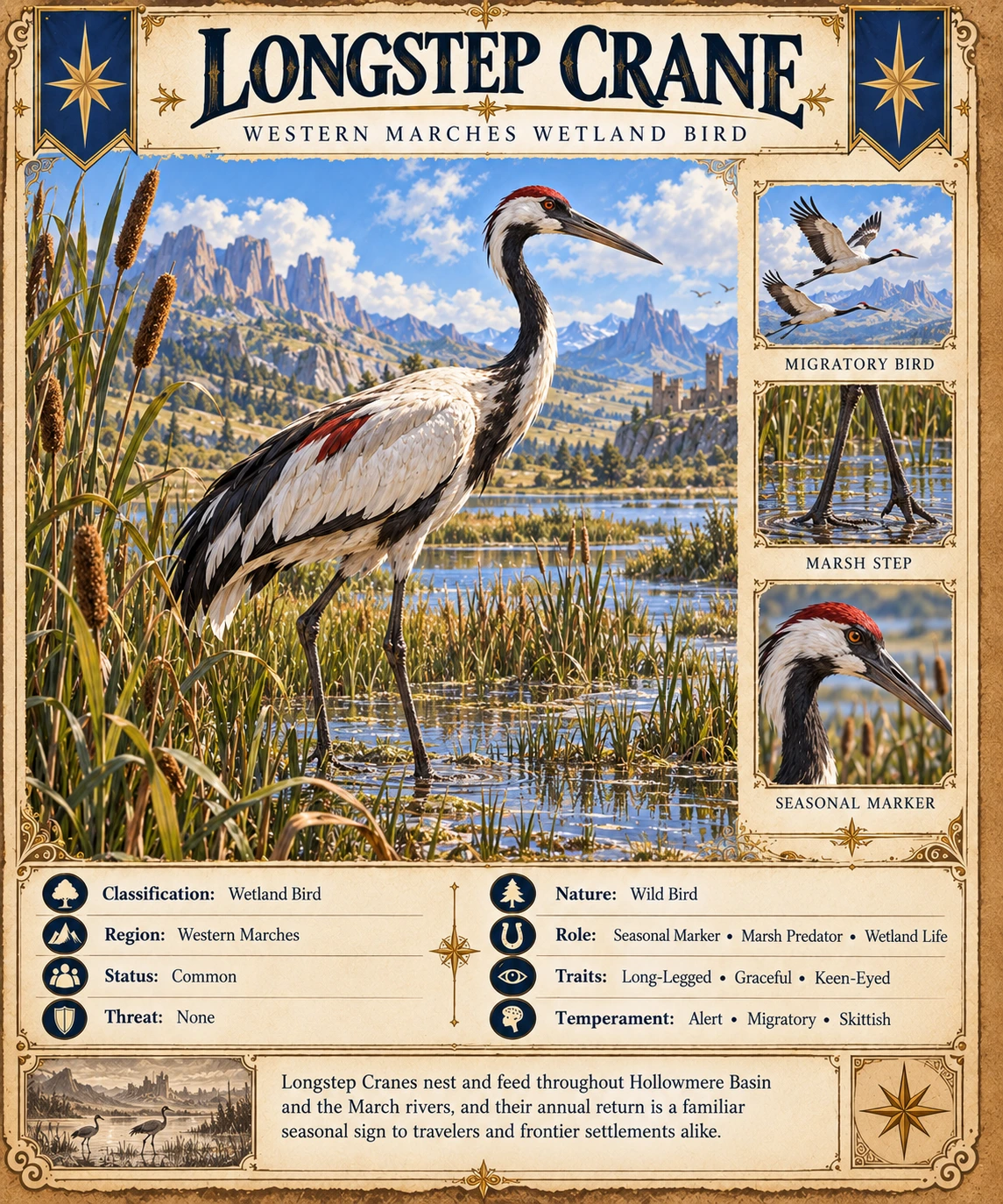 Animal
Longstep Crane
Migratory wetland bird of Hollowmere Basin and river meadows; arrival is a traditional seasonal marker.
Enlarge approved cardTracking Info & Deeper Ethology
Tracking Info
Three-toed prints form long straight lines through mud and flooded meadow. Roosting flats are littered with dropped down and narrow probe-holes. Migratory flocks leave broad disturbed bands in Stormreed.
Deeper Ethology
Longstep Cranes are highly seasonal and pair-bonded. Their arrivals and departures are reliable cultural calendar markers. Flocks become noisy and restless before major pressure changes. Adults perform distraction displays around nests rather than fighting most intruders directly. A migration arriving unusually early, late, or from the wrong direction is treated by local riders as a meaningful ecological warning.
When This Is Wrong
A break from these patterns is a reason to investigate. Injury, hunger, breeding, severe weather, migration, displacement, disease, mana instability or learned responses to people can change behavior. Observe the context before deciding what the sign means.
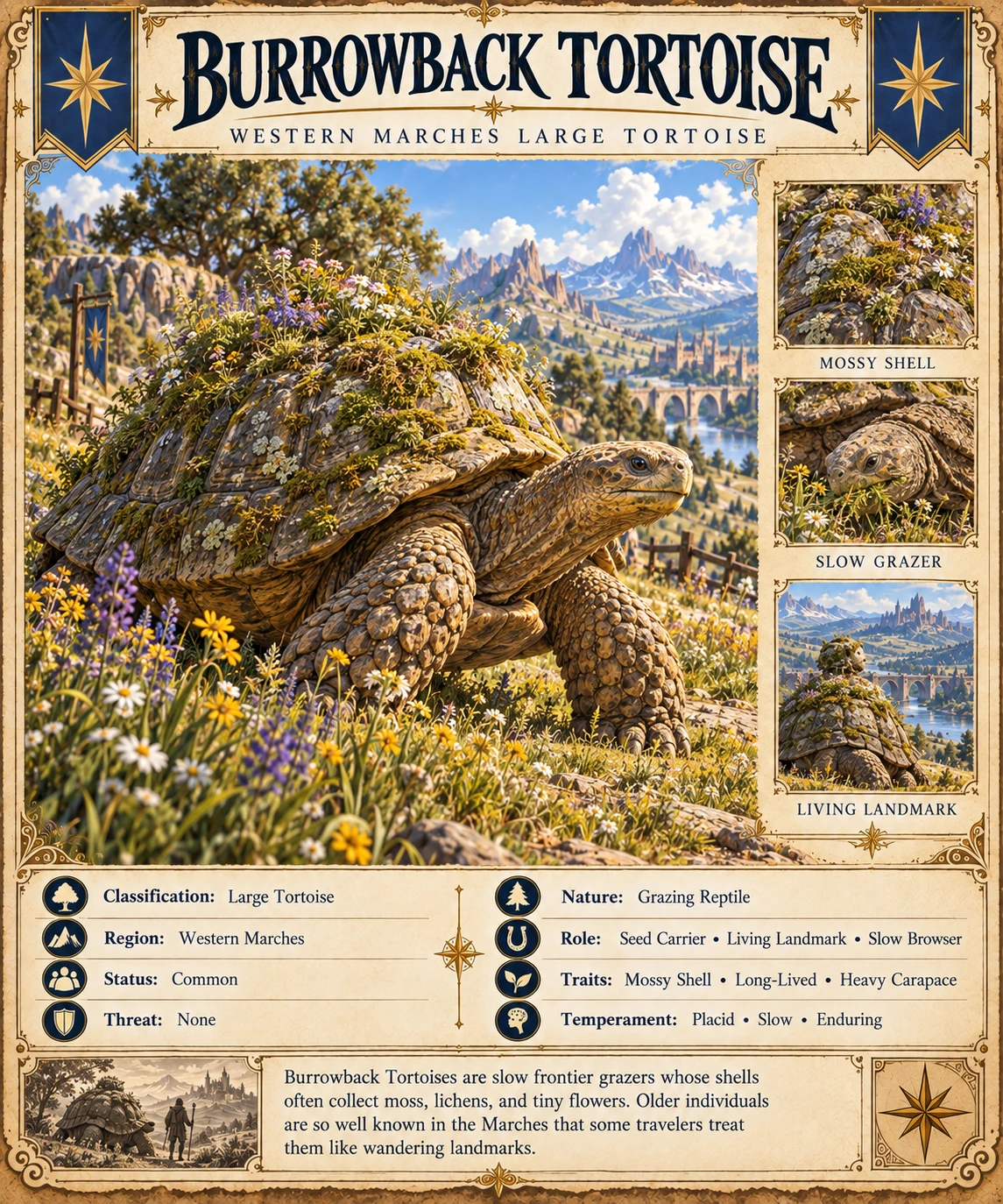 Animal
Burrowback Tortoise
Large grazing tortoise whose shell accumulates moss and flowers; old individuals may be treated like moving landmarks.
Enlarge approved cardTracking Info & Deeper Ethology
Tracking Info
Broad dragging trails flatten vegetation and show paired claw grooves. Old feeding routes accumulate clipped low plants. Moss, flowers, and insects dropped from the shell can mark a path long after the animal passes.
Deeper Ethology
Burrowbacks are slow-moving grazers with extremely stable seasonal ranges. Elders remember reliable water and mineral sites and may repeat routes for decades. Small animals and insects use the living shell-gardens as habitat. They withdraw rather than attack, but an adult can crush or shove obstacles through sheer mass. Sudden abandonment of a traditional route usually means flooding, sustained disturbance, or a new large predator.
When This Is Wrong
A break from these patterns is a reason to investigate. Injury, hunger, breeding, severe weather, migration, displacement, disease, mana instability or learned responses to people can change behavior. Observe the context before deciding what the sign means.
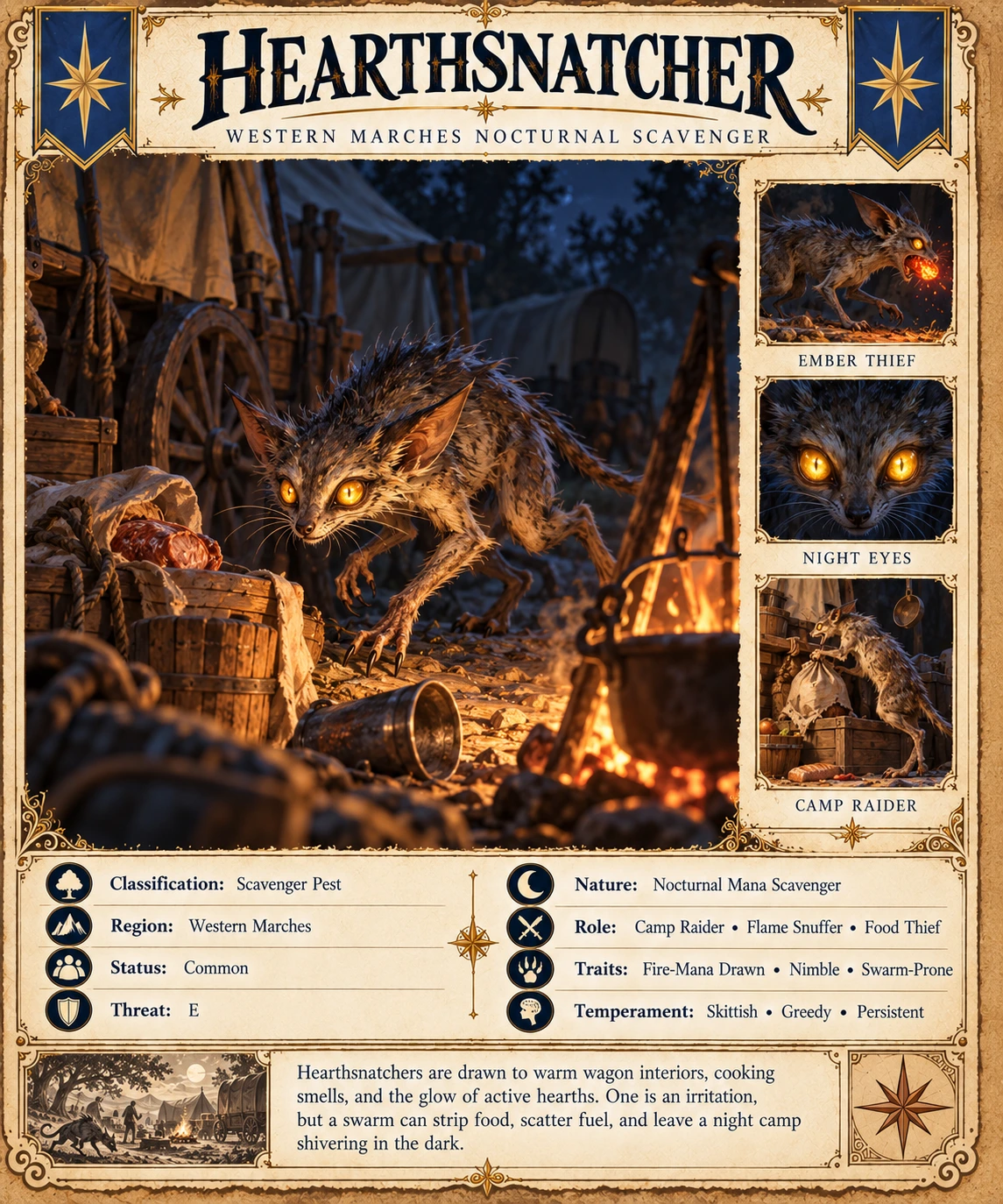 Mana Beast · Encounter Threat E
Hearthsnatcher
Nocturnal scavenger attracted to fire mana, cooking smells, and warm wagon interiors; dangerous in swarms.
Enlarge approved cardTracking Info & Deeper Ethology
Tracking Info
Camps show missing kindling, disturbed ash, soot-smudged paw/hand marks, and small drag lines leading toward cover. Flames may gutter repeatedly despite normal fuel. Food often disappears from the warmest side of a camp first.
Deeper Ethology
Hearthsnatchers are nocturnal scavengers drawn to heat, cooking odor, and fire mana. They watch camp routines before entering and often learn which person tends the fire. Individuals probe; groups exploit. A confident swarm may extinguish or scatter fuel to create confusion while others raid food. They are curious, quarrelsome with one another, and quick to retreat from coordinated pursuit. Populations near settlements become better at doors, latches, ash pits, and chimney routes than wilderness animals.
When This Is Wrong
A break from these patterns is a reason to investigate. Injury, hunger, breeding, severe weather, migration, displacement, disease, mana instability or learned responses to people can change behavior. Observe the context before deciding what the sign means.
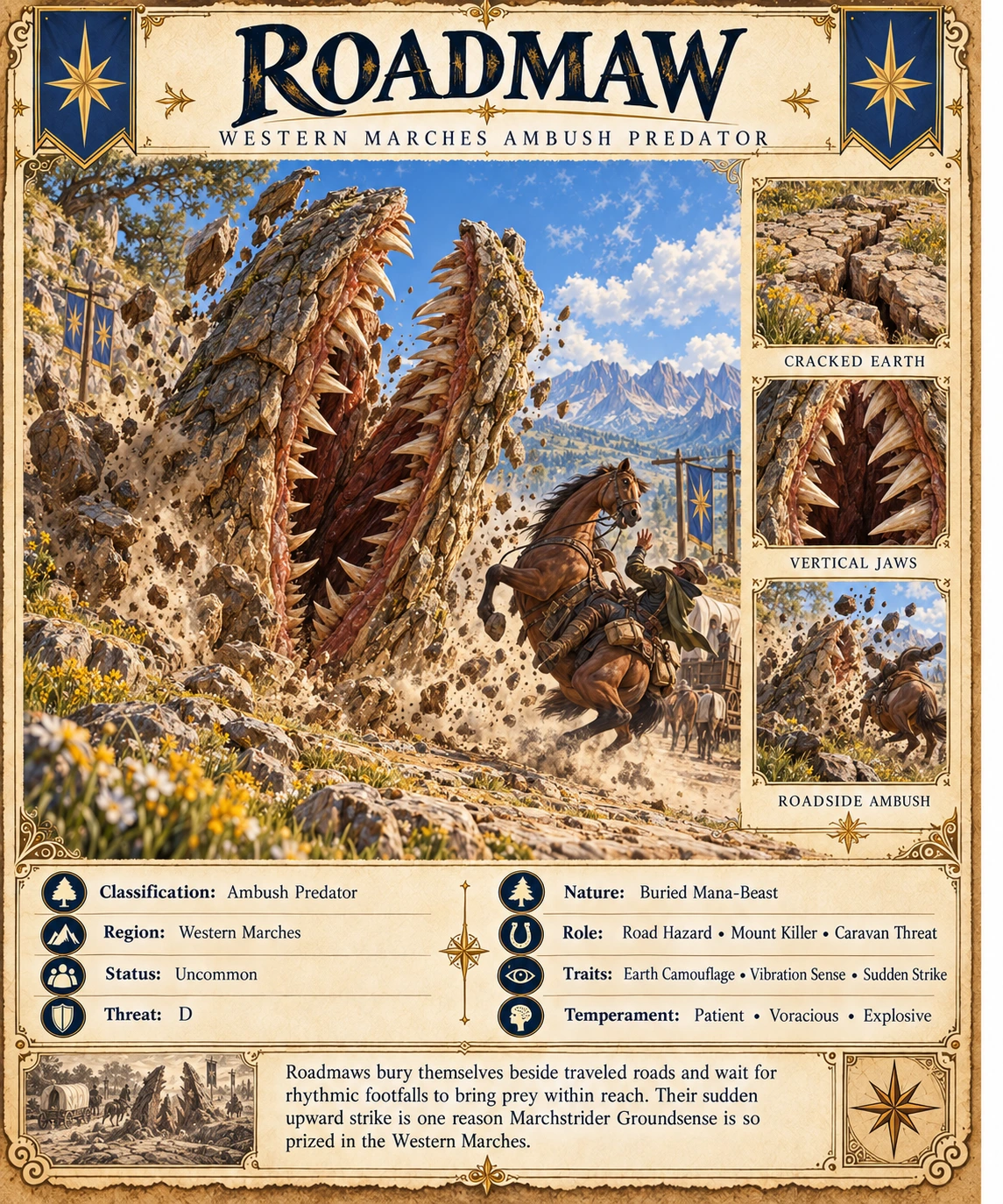 Mana Beast · Encounter Threat D
Roadmaw
Buried roadside ambush predator sensing rhythmic footfalls; especially detectable by Marchstrider Groundsense.
Enlarge approved cardTracking Info & Deeper Ethology
Tracking Info
The clearest sign is not a footprint but a false patch of road: cracked earth with subtly radial fractures, unnaturally compacted edges, and small stones arranged by repeated underground movement. Nearby burrowers often vacate first. Tremor-sensing animals become reluctant to cross the patch.
Deeper Ethology
Roadmaws are patient vibration hunters. They settle where repeated footfall patterns promise traffic and learn the cadence of common wagons, herds, and patrols. They do not spring at every vibration; they wait for weight, rhythm, and distance to align. After a failed strike they may relocate several body lengths and rebury rather than immediately attack again. Heavy irregular stomping can confuse a young animal; old Roadmaws learn to ignore common decoy rhythms. A Roadmaw surfacing far from roads usually signals displacement, breeding movement, flooding, or pressure from something larger.
When This Is Wrong
A break from these patterns is a reason to investigate. Injury, hunger, breeding, severe weather, migration, displacement, disease, mana instability or learned responses to people can change behavior. Observe the context before deciding what the sign means.
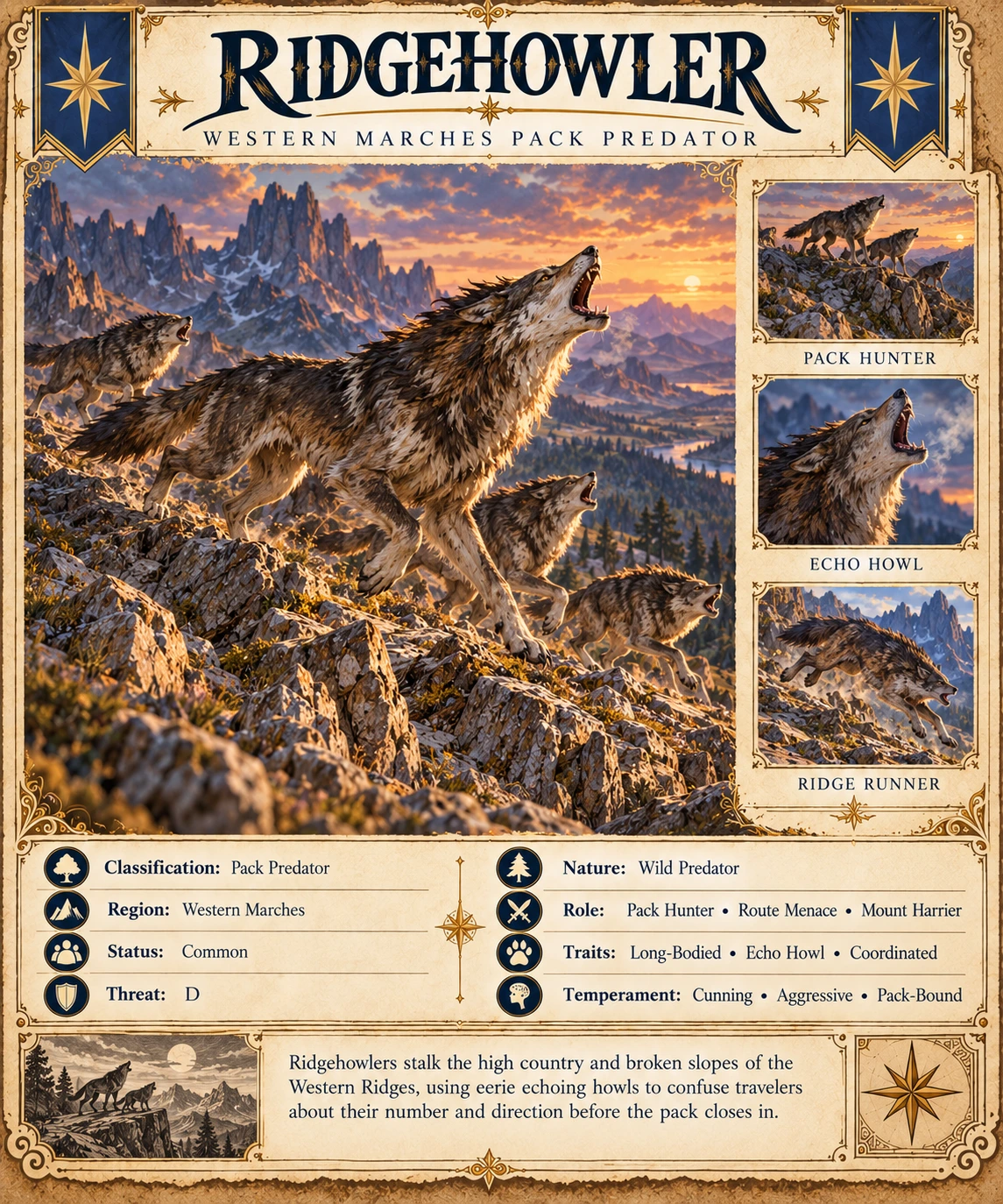 Mana Beast · Encounter Threat D
Ridgehowler
Long-bodied pack predator whose howl creates misleading echoes.
Enlarge approved cardTracking Info & Deeper Ethology
Tracking Info
Narrow canine-like prints often appear in staggered parallel lines because packs travel offset from one another. The defining sign is acoustic: howls return from misleading directions, while the true pack often moves through the quiet gap between echoes. Scat and scent marks are placed on exposed ridge saddles.
Deeper Ethology
Ridgehowlers coordinate hunts through resonance and terrain. Packs use call-and-move patterns to push prey away from apparent danger and toward hidden members. Juveniles practice echo placement in low-stakes chases. Packs know their ridges intimately and are far less effective when displaced onto flat ground. A missing expected echo, rather than the loudest sound, is often the best clue to movement. Packs that howl repeatedly without repositioning are usually warning rather than hunting.
When This Is Wrong
A break from these patterns is a reason to investigate. Injury, hunger, breeding, severe weather, migration, displacement, disease, mana instability or learned responses to people can change behavior. Observe the context before deciding what the sign means.
 Mana Beast · Encounter Threat C
Gallows Stag
Huge territorial stag-like Mana Beast with crooked black antlers and a fear-inducing mana call.
Enlarge approved cardTracking Info & Deeper Ethology
Tracking Info
Large cloven prints are accompanied by antler-scrapes higher than ordinary deer. Hanging moss may be found snagged on branches in a corridor. Before direct sighting, travelers sometimes report an unnatural urge to separate or flee in different directions.
Deeper Ethology
Gallows Stags are territorial rather than actively predatory. Mature individuals use fear-charged calls to break the cohesion of approaching groups, then charge the isolated or nearest perceived challenger. Outside peak territorial periods they prefer to watch from cover and move parallel to travelers. Antlers and symbiotic moss are renewed seasonally, making mature sign especially obvious before and during rut. Herd animals panic sooner than trained mounts because the call exploits group-flight instinct.
When This Is Wrong
A break from these patterns is a reason to investigate. Injury, hunger, breeding, severe weather, migration, displacement, disease, mana instability or learned responses to people can change behavior. Observe the context before deciding what the sign means.
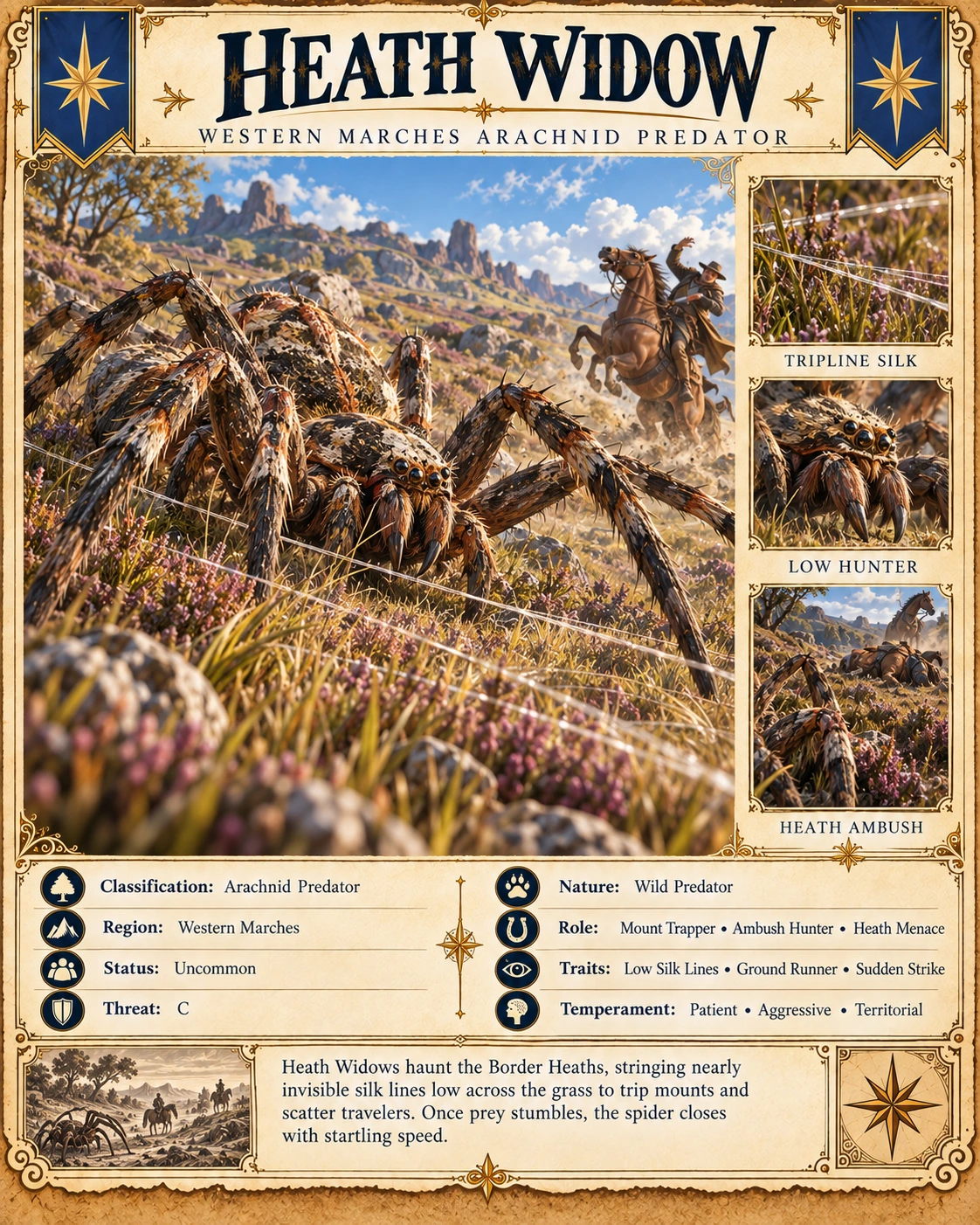 Mana Beast · Encounter Threat C
Heath Widow
Huge ground-running spider using low silk trip-lines through grass.
Enlarge approved cardTracking Info & Deeper Ethology
Tracking Info
Low silk lines appear shin- to mount-knee-high through heather and grass, often almost invisible except for dew. Trip-lines converge toward shallow ground hollows rather than overhead webs. Drained prey may be dragged a short distance but is rarely wrapped into hanging bundles.
Deeper Ethology
Heath Widows hunt by disrupting movement. They place low silk across habitual animal paths, wait off-angle, and rush only after prey trips or slows. They prefer open heath with enough cover to conceal a ground sprint. Females defending egg chambers are much less tolerant than ordinary hunting adults. Repeatedly cut lines teach local spiders to move anchor points or place secondary strands behind the obvious first line.
When This Is Wrong
A break from these patterns is a reason to investigate. Injury, hunger, breeding, severe weather, migration, displacement, disease, mana instability or learned responses to people can change behavior. Observe the context before deciding what the sign means.
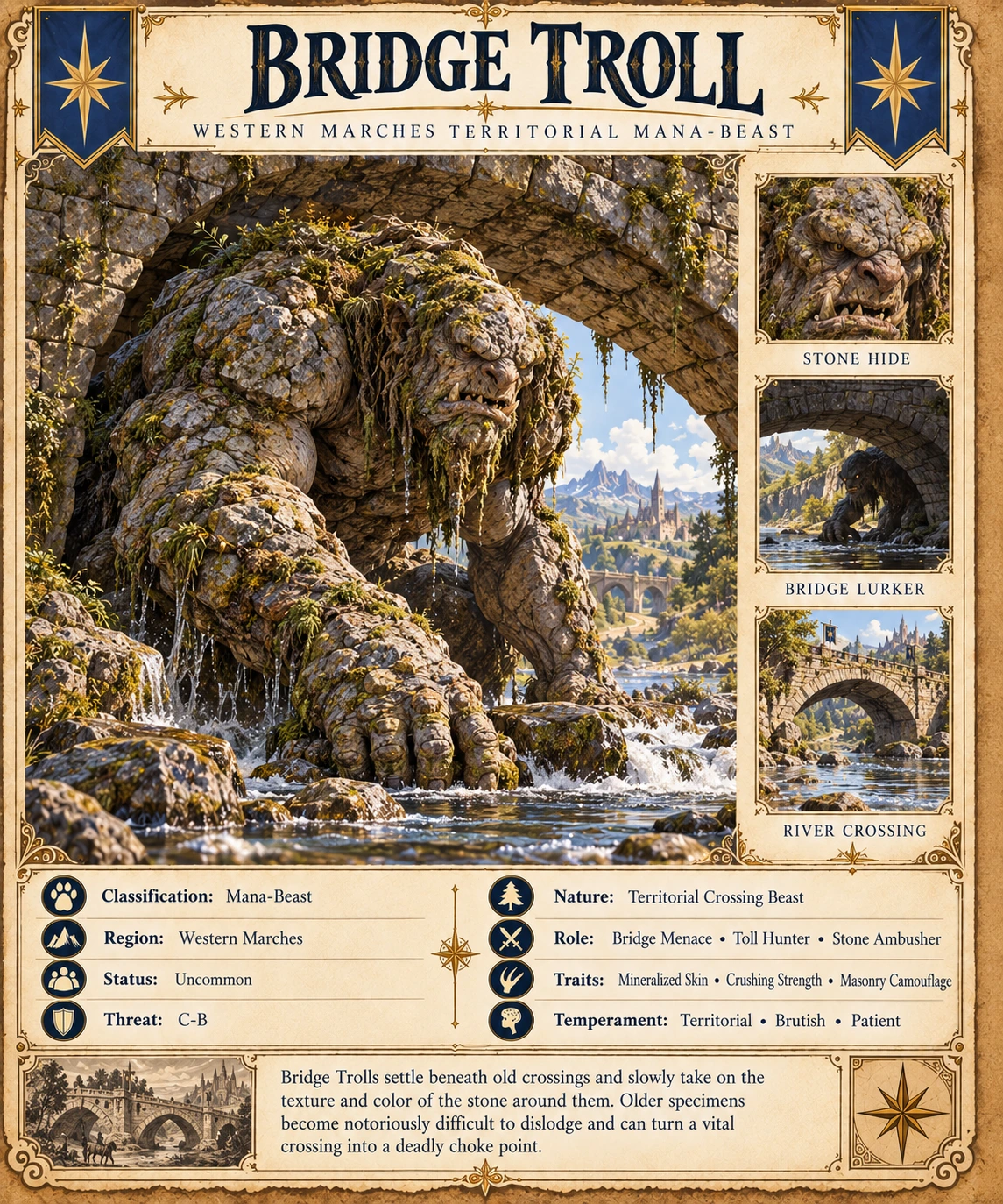 Mana Beast · Encounter Threat C–B
Bridge Troll
Territorial Mana Beast nesting beneath old stone crossings; mineralized skin takes on properties of its bridge.
Enlarge approved cardTracking Info & Deeper Ethology
Tracking Info
Mineral flakes accumulate beneath favored bridge arches. Stonework develops rubbed, polished patches near nest entrances. Older animals leave footprints that partially resemble the local masonry texture because of mineralized skin debris.
Deeper Ethology
Bridge Trolls are site-bound Mana Beasts that gradually incorporate the mineral character of the crossing they occupy. They are most aggressive toward repeated vibration, structural tampering, and passage through the immediate nest zone. They learn the difference between ordinary traffic and crews carrying hammers, picks, or demolition tools. Juveniles shift bridges more readily; old animals may defend one crossing for years. A Troll abandoning an intact long-held bridge is considered a serious warning of structural failure, magical disturbance, or displacement.
When This Is Wrong
A break from these patterns is a reason to investigate. Injury, hunger, breeding, severe weather, migration, displacement, disease, mana instability or learned responses to people can change behavior. Observe the context before deciding what the sign means.
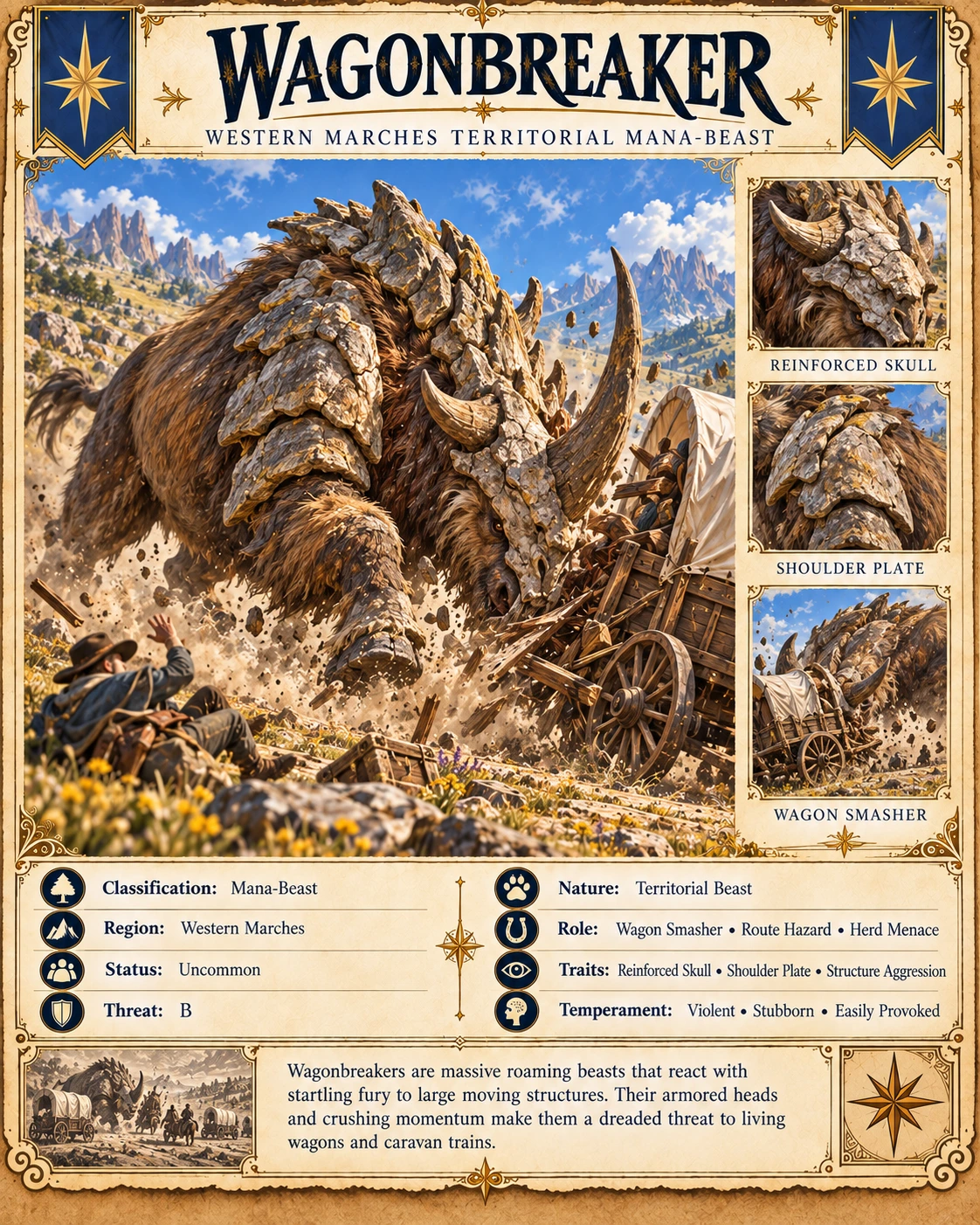 Mana Beast · Encounter Threat B
Wagonbreaker
Massive territorial Mana Beast with reinforced skull/shoulder plate; reacts violently to large moving structures, including living wagons.
Enlarge approved cardTracking Info & Deeper Ethology
Tracking Info
Bark, signposts, and fence rails show broad impact scars at shoulder height. Trails end in churned soil where the animal turned to meet large moving objects. Broken wagon fragments may be scattered laterally rather than eaten or carried.
Deeper Ethology
Wagonbreakers are territorial Mana Beasts, not carnivores. Large moving silhouettes, especially wagons, trigger challenge behavior. They posture broadside, scrape, then commit to a skull-and-shoulder impact. Solitary animals learn common road traffic and may ignore small carts while still attacking living wagons or military trains. During breeding or resource stress the trigger threshold drops sharply. Their violence is about displacement and dominance, not feeding.
When This Is Wrong
A break from these patterns is a reason to investigate. Injury, hunger, breeding, severe weather, migration, displacement, disease, mana instability or learned responses to people can change behavior. Observe the context before deciding what the sign means.
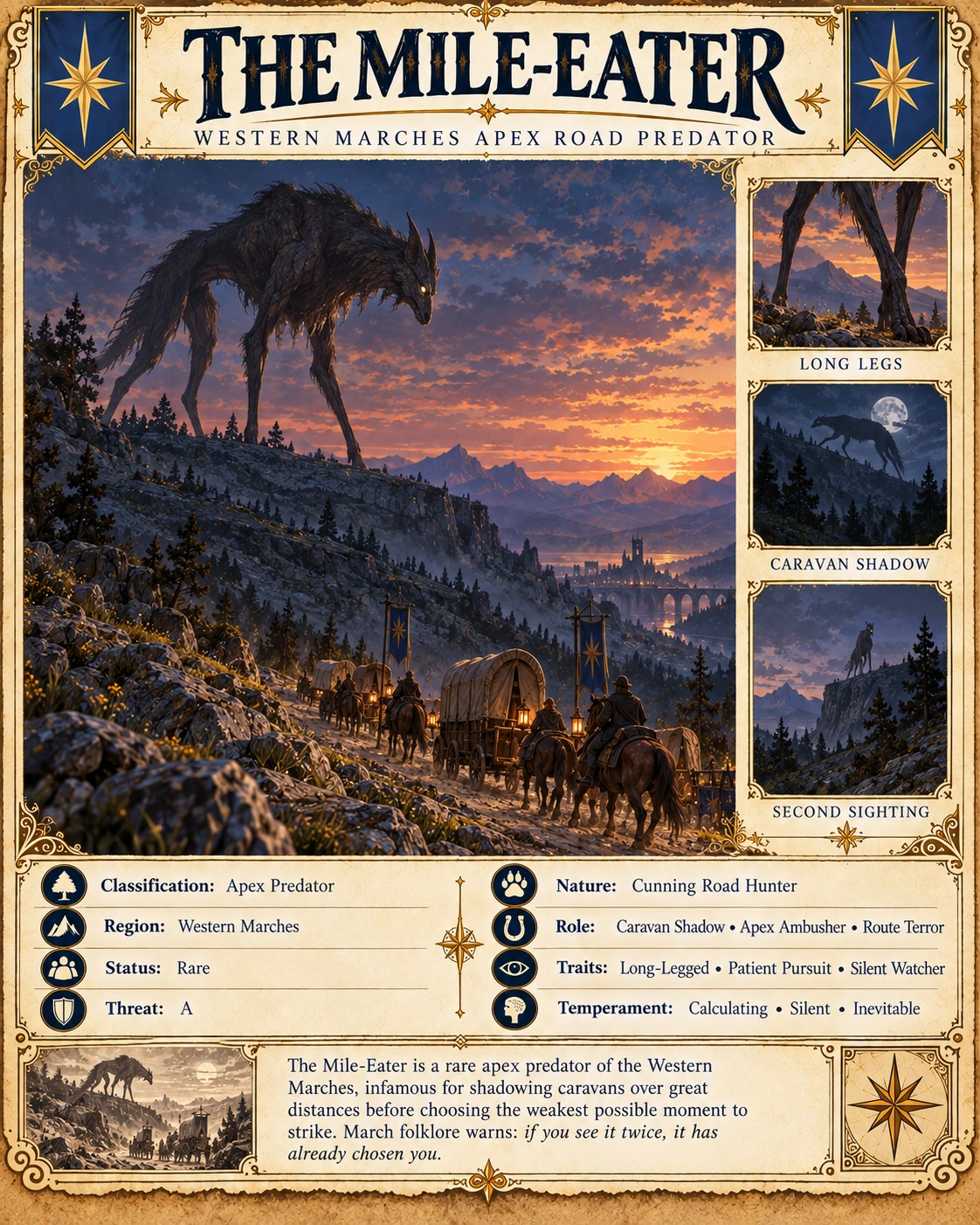 Mana Beast · Encounter Threat A
The Mile-Eater
Rare apex road predator that shadows caravans, studies pace and defenses, and attacks at a weak moment. March folklore: “If you see it twice, it has already chosen you.”
Enlarge approved cardTracking Info & Deeper Ethology
Tracking Info
Very long-stride tracks appear intermittently rather than as a continuous trail because the creature often parallels roads from cover. Repeated sightings of the same distant silhouette at different points are a stronger sign than prints. Scavengers avoid its travel line even when carrion is present.
Deeper Ethology
The Mile-Eater is a patient pursuit apex. It studies a caravan's speed, guard rotations, weakest animals, camp routine, and terrain before choosing a moment. It does not waste energy on a strong formation. Old individuals may shadow for days, testing reactions with partial appearances. The creature's defining behavior is assessment. Travelers who see it once may merely be observed; seeing it repeatedly at changing angles means the animal is actively updating its attack plan.
When This Is Wrong
A break from these patterns is a reason to investigate. Injury, hunger, breeding, severe weather, migration, displacement, disease, mana instability or learned responses to people can change behavior. Observe the context before deciding what the sign means.
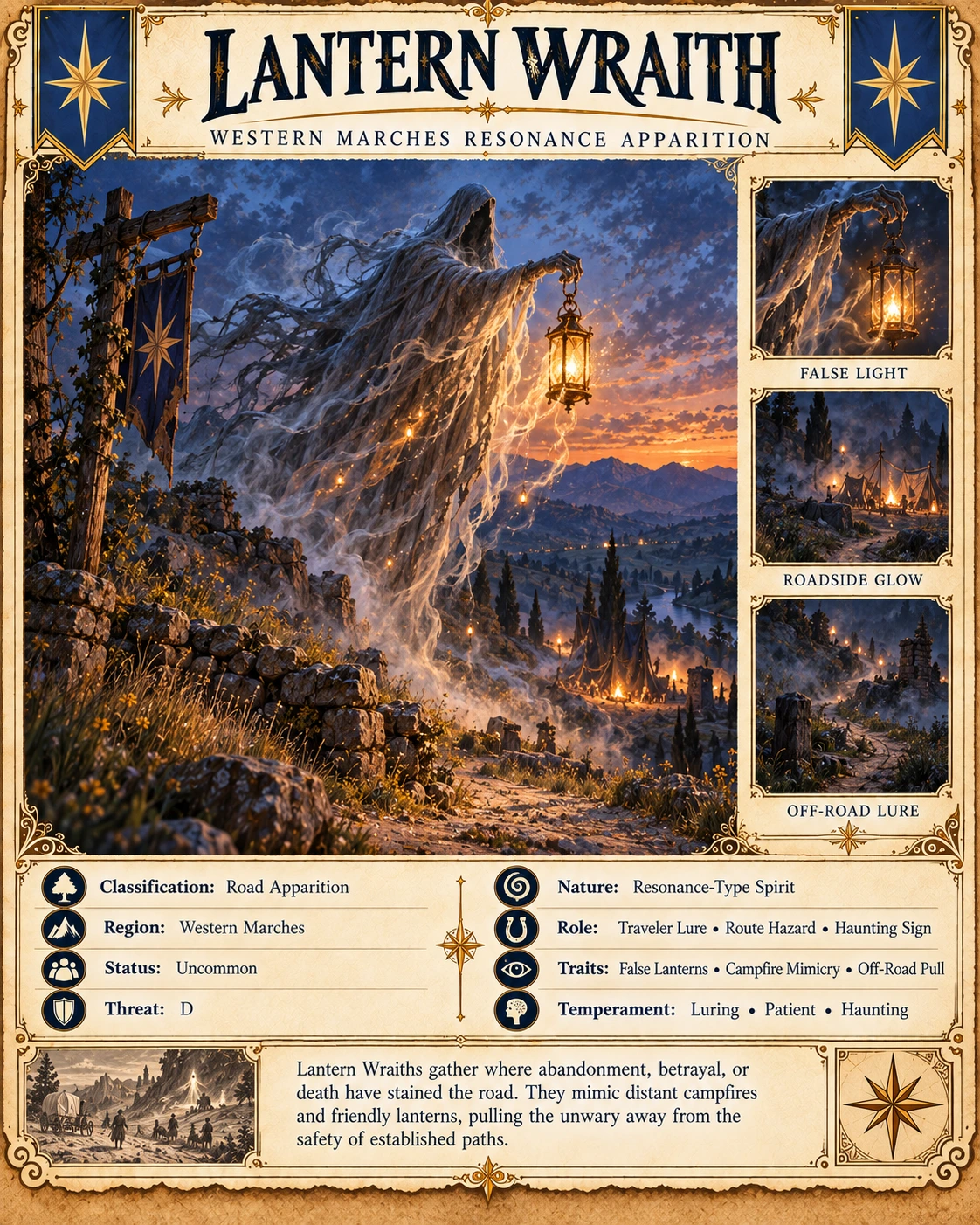 Monster · Encounter Threat D
Lantern Wraith
Resonance-type road apparition that mimics distant campfires and lanterns to lure travelers off established routes; this remains a true monster, not a Mana Beast.
Enlarge approved cardTracking Info & Deeper Ethology
Tracking Info
False campfire light appears where no smoke, fuel smell, heat, or footprints exist. Light may remain visible through terrain that should block it. Travelers who follow it often leave a straight road at increasingly poor angles.
Deeper Ethology
Lantern Wraiths are Resonance monsters shaped by repeated abandonment, betrayal, and death around travel corridors. They imitate familiar safety cues rather than hunting like animals. Their pattern is lure, separation, disorientation, and continued draw. They become more convincing when travelers are tired or emotionally primed to seek shelter. They do not feed biologically; their “behavior” is a repeated predatory resonance pattern. A Wraith appearing on a newly built safe road implies older history beneath the route or a newly repeated tragedy.
When This Is Wrong
A break from these patterns is a reason to investigate. Injury, hunger, breeding, severe weather, migration, displacement, disease, mana instability or learned responses to people can change behavior. Observe the context before deciding what the sign means.
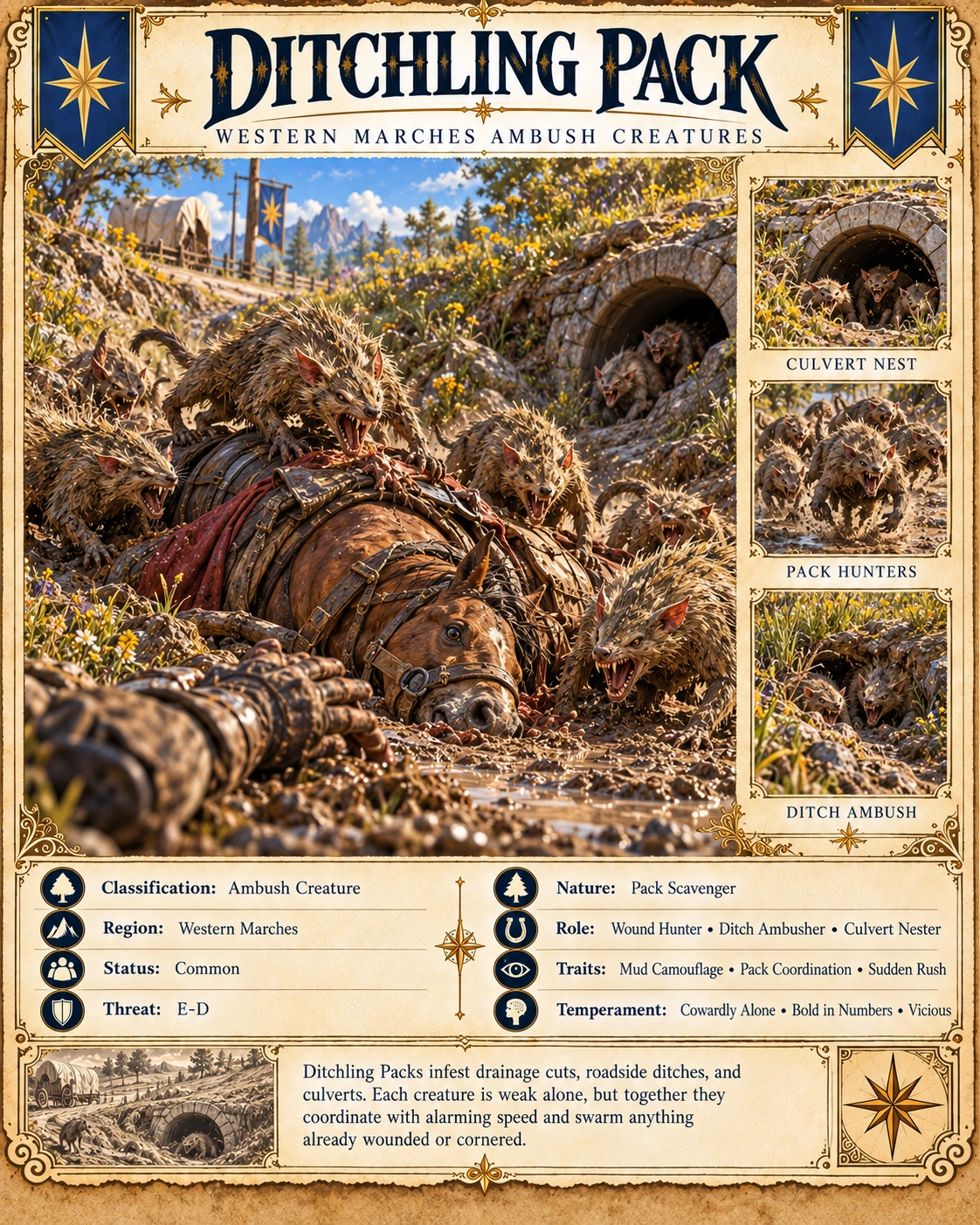 Monster · Encounter Threat E–D
Ditchling Pack
Coordinated mud-colored roadside ambushers living in drainage cuts and culverts; true monsters rather than Mana Beasts.
Enlarge approved cardTracking Info & Deeper Ethology
Tracking Info
Small muddy prints appear in culverts, ditch bottoms, and drainage cuts, often with too many overlapping paths to count individuals. Wounded animals may show shallow repeated bites low on the legs. Bits of stolen cloth or bone collect in concealed roadside pockets.
Deeper Ethology
Ditchlings are weak individually and dangerous through coordination. Packs wait for injury, bogging, or distraction rather than challenging healthy travelers head-on. They communicate with clicks and wet slaps that carry through drainage channels. They learn where wagons slow, where horses stumble, and where runoff hides scent. If Ditchlings attack healthy prey in open daylight, something has likely displaced them or driven them unusually hungry.
When This Is Wrong
A break from these patterns is a reason to investigate. Injury, hunger, breeding, severe weather, migration, displacement, disease, mana instability or learned responses to people can change behavior. Observe the context before deciding what the sign means.
“Don’t stab the part you plan to sell.”
Mana Beasts yield Common Loot by default. Higher threat can mean more valuable, durable or potent material without changing that default rarity. The harvest itself is graded Ruined, Field Grade, Clean or Prime.
Kill placement, damaged organs, field dressing, delay, contamination and preservation all affect value. Knives, bone saws, jars, waxed wraps, salt, mana-preservation cases, specimen tags and Guild seals belong in the working kit. Each Mana Beast’s record lists its approved reagents and uses.
Field competence, the First Circuit and “feeding the dungeon”Hollowmere’s history
Reveal Livia II spoilers: the Hollowmere betrayal
Livia admits an Everance delegation under a flag of peace, shares her table and permits mixed watches. Conspirators murder the gate guards and open Hollowmere to a prepared outside force. Cassian Everance commands the operation and orders survivors removed. Some personnel comply; others refuse. Responsibility belongs to individuals and their choices.
Livia protects survivors before her later Wolfhaven rebuilding. She leaves in spring and undertakes the sustained Cassian hunt while still bearing House Valecourt’s Gold Lion. The independent Pink Lions company and its heraldry arise only after her later return to Wolfhaven and decision to stay.
A frontier perspective
Livia’s series follows Western Marches politics, alliances and intrigue. It begins alongside The Winter Roads and follows a distinct story lane.
Livia the Lioness · Livia the Lioness II — Coming Soon · Reading timeline