
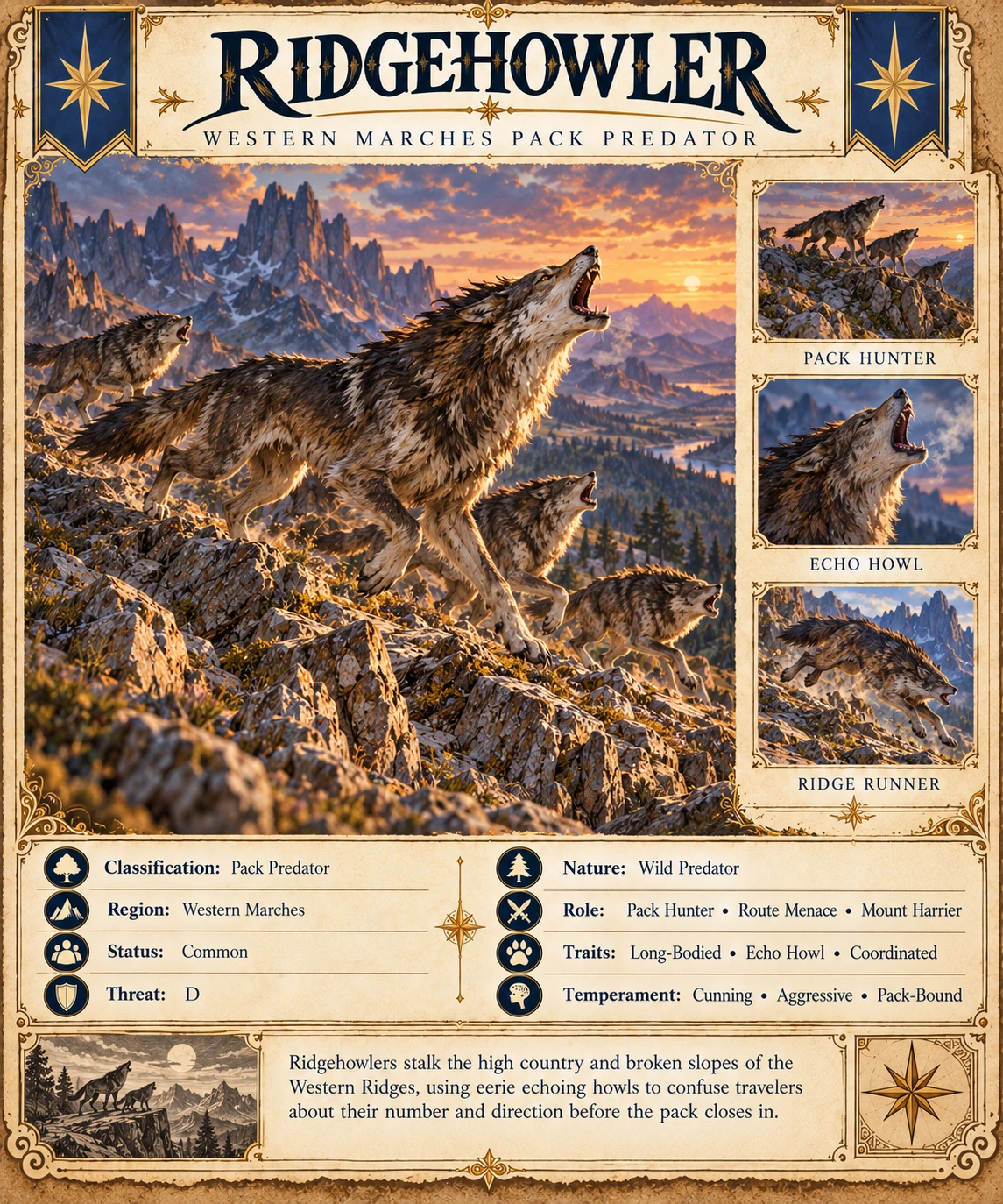
Ridgehowler
Long-bodied pack predator whose howl creates misleading echoes.
Encounter Threat D-class level threat
Long-bodied pack predator whose howl creates misleading echoes.
Common Loot and reagents - Echo Bladder — Resonance organ; signaling horns, hunting calls, sound decoys, acoustic traps, low-grade silence/echo enchantments. - Whisperbone — Inner-ear bone conducting vibration; listening devices, courier whistles, detection charms. - Hushhide — Neck/shoulder hide that dampens vibration; stealth gear, workshop padding, soundproof containers.
Wild or unbound members of this lineage are lethally hostile to people on meaningful detection. Established bonded, domesticated, Companioner-trained or canonically socialized individuals are exceptions. Ecology and intelligence do not erase the wild baseline.
Tracking Info
Narrow canine-like prints often appear in staggered parallel lines because packs travel offset from one another. The defining sign is acoustic: howls return from misleading directions, while the true pack often moves through the quiet gap between echoes. Scat and scent marks are placed on exposed ridge saddles.
Deeper Ethology
Ridgehowlers coordinate hunts through resonance and terrain. Packs use call-and-move patterns to push prey away from apparent danger and toward hidden members. Juveniles practice echo placement in low-stakes chases. Packs know their ridges intimately and are far less effective when displaced onto flat ground. A missing expected echo, rather than the loudest sound, is often the best clue to movement. Packs that howl repeatedly without repositioning are usually warning rather than hunting. Wild, unbound Mana Beasts are lethally hostile to people upon meaningful detection. Ambush, flanking, pursuit and attack timing follow the species’ established senses and tactics. Early warning and staying beyond detection can prevent contact; once detected, survival requires force, earned deterrence, specialized established abilities or escape. Ordinary distraction or handling does not make the creature safe.
When This Is Wrong
A break from these patterns is a reason to investigate. Injury, hunger, breeding, severe weather, migration, displacement, disease, mana instability or learned responses to people can change behavior. Observe the context before deciding what the sign means.
Connected world
Follow the relationships
Each connection opens the matching canonical record or a focused Codex search when that subject does not yet have its own public record.
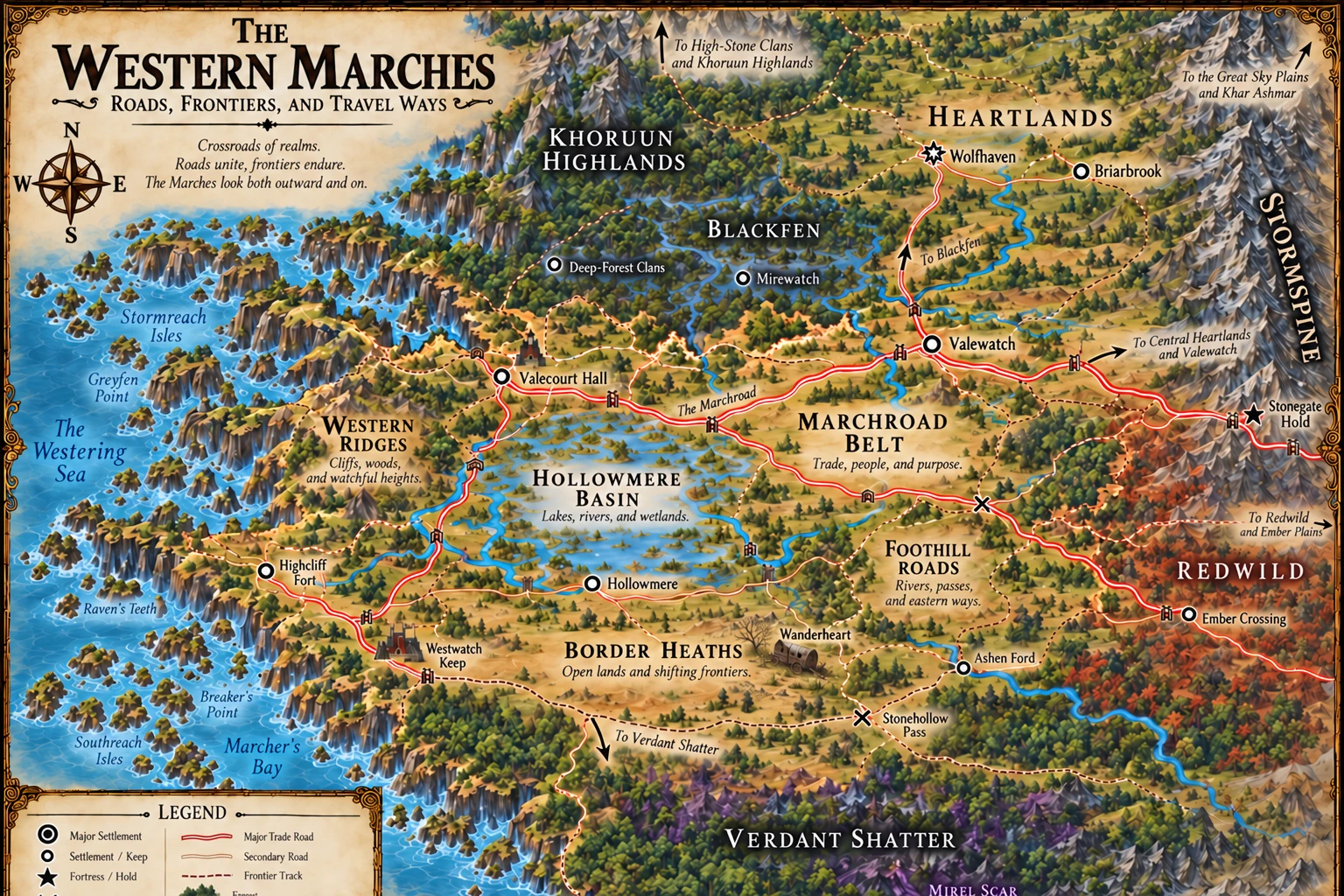 Heartlands subregion
Western Marches
The Heartlands’ western road-and-rider frontier: green-gold heaths, wooded ridges, living wagons, fortified crossings and service houses.
Open record →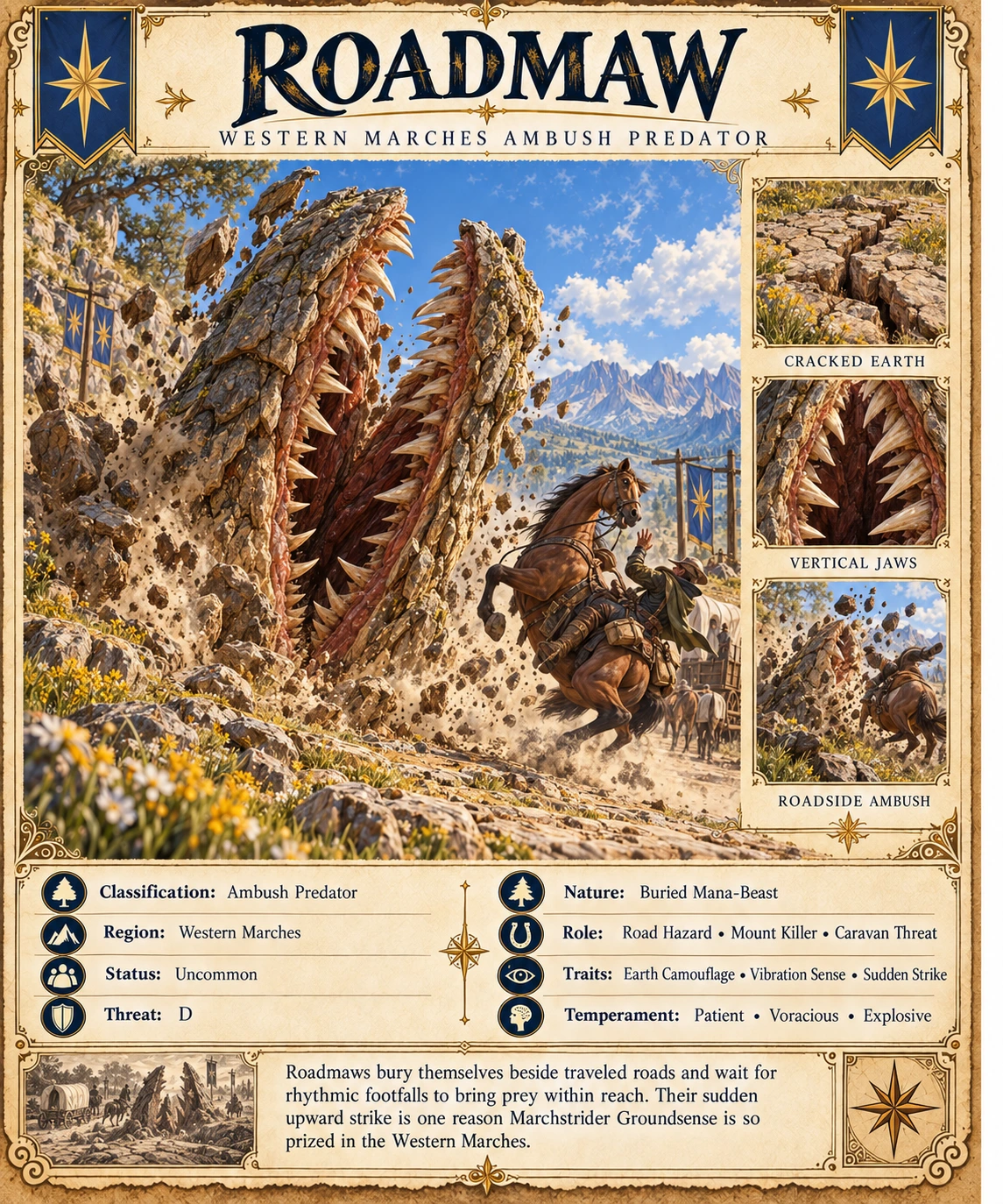 World Rule
Mana Beasts
Natural creatures with innate magical biology: an ecological classification, not a power tier.
Open record →