
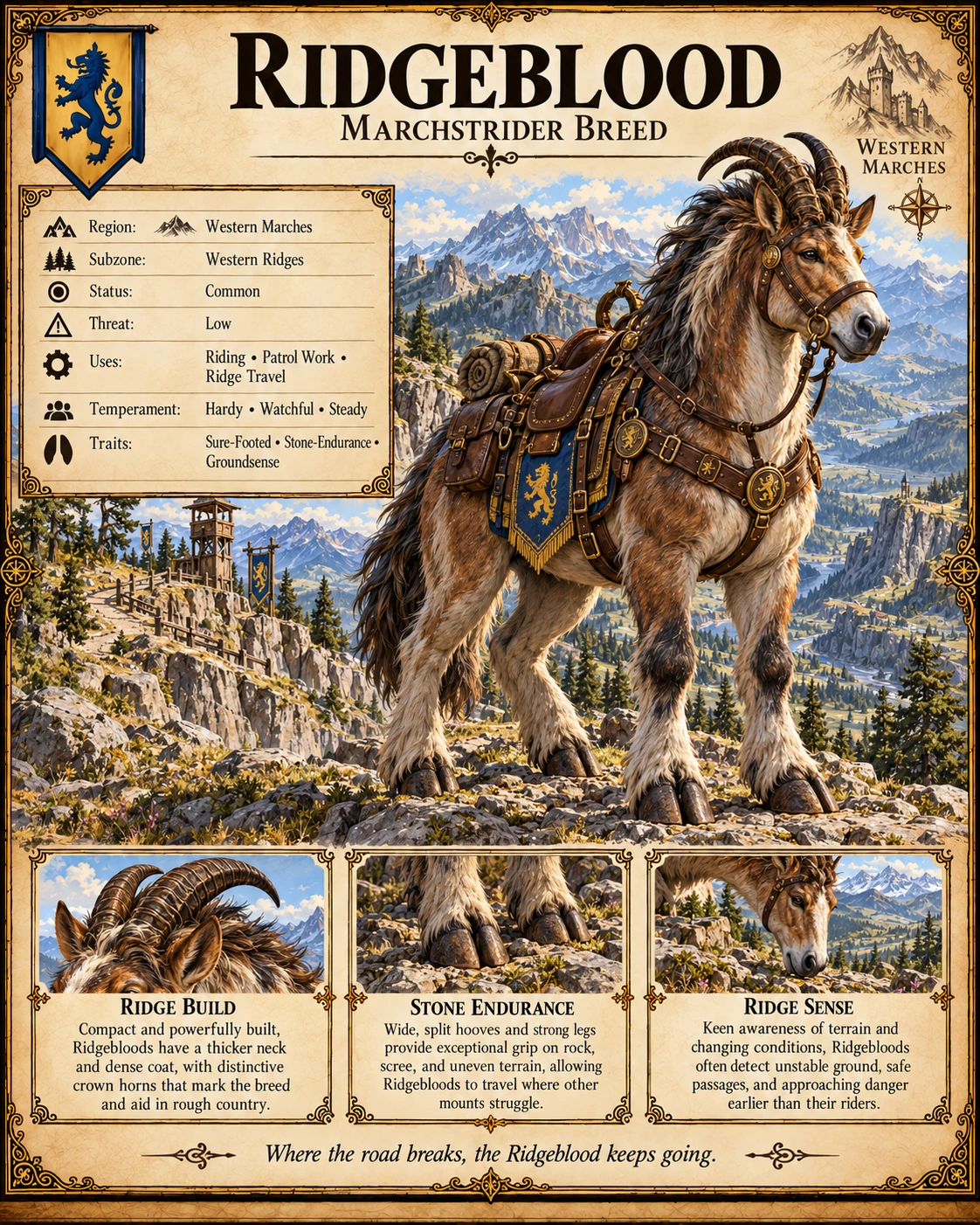
Ridgeblood Marchstrider
Tall, narrow, exceptionally sure-footed; favored by ridge scouts and messengers.
Tall, narrow, exceptionally sure-footed; favored by ridge scouts and messengers. Marchstriders are road-bonded through care and progressively longer journeys. The First Road marks the first successful full-day ride.
Tracking Info
Split-hoof prints are broad and unusually even, with shallow paired horn-scrapes where animals lower their heads to investigate unstable ground. Herd routes show repeated three-beat hoof dents near buried hazards. Droppings often contain Goldmane Grass and Waybread Clover seed.
Deeper Ethology
Marchstriders are intensely social and read the movement of neighboring herd members before reacting to danger. Their Groundsense is strongest while standing still or walking slowly; experienced riders learn that sudden refusal, synchronized ear-turning, and the three-beat warning knock are information, not stubbornness. Young animals imitate adult route choices and can learn the location of bad bridges, unstable shoulders, and habitual Roadmaw ground. Working lines bond strongly to routine, team position, and familiar handlers. Panic spreads quickly through an untrained herd, while veteran wagon teams often freeze and orient together before bolting.
When This Is Wrong
A break from these patterns is a reason to investigate. Injury, hunger, breeding, severe weather, migration, displacement, disease, mana instability or learned responses to people can change behavior. Observe the context before deciding what the sign means.