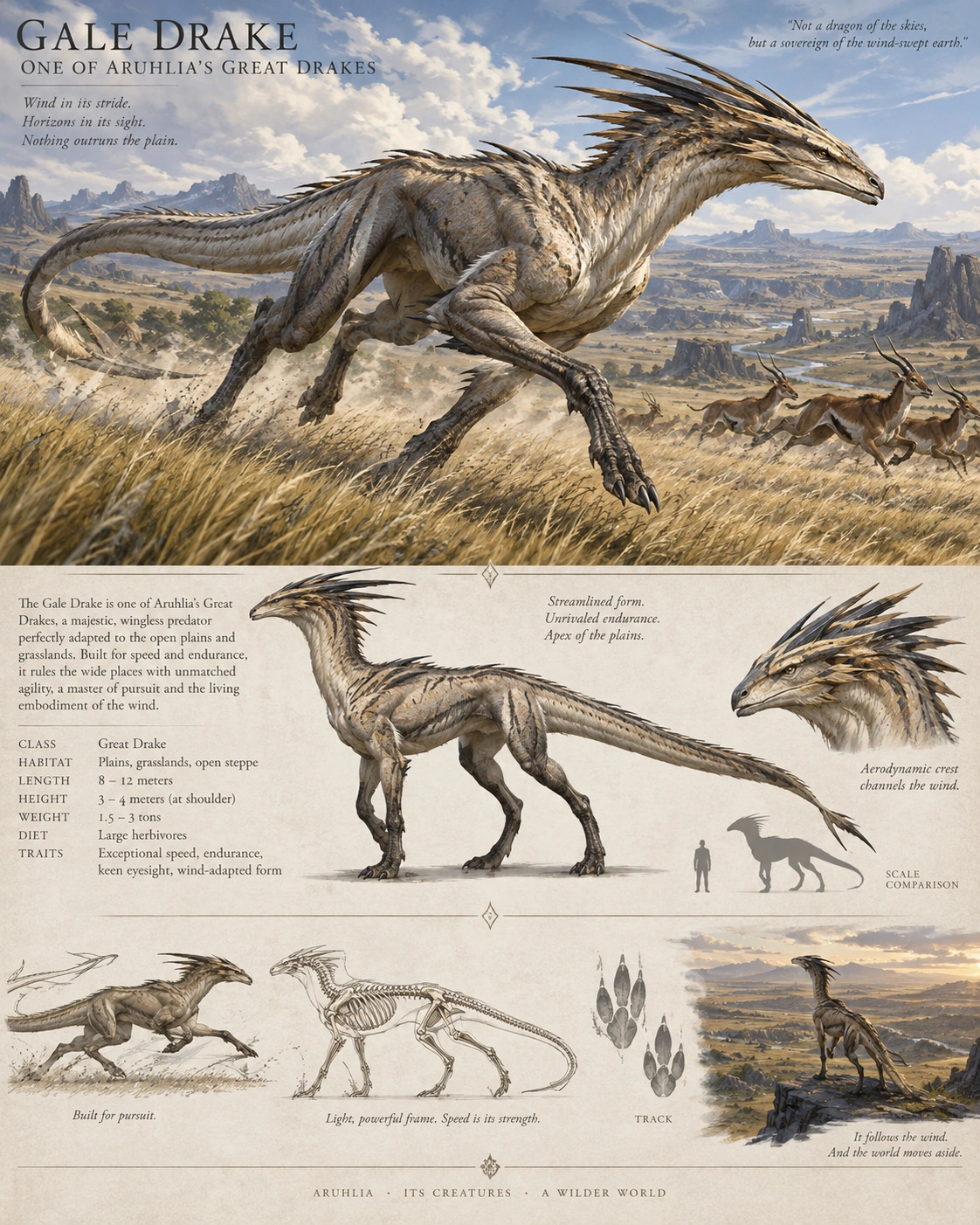
Gale Drake
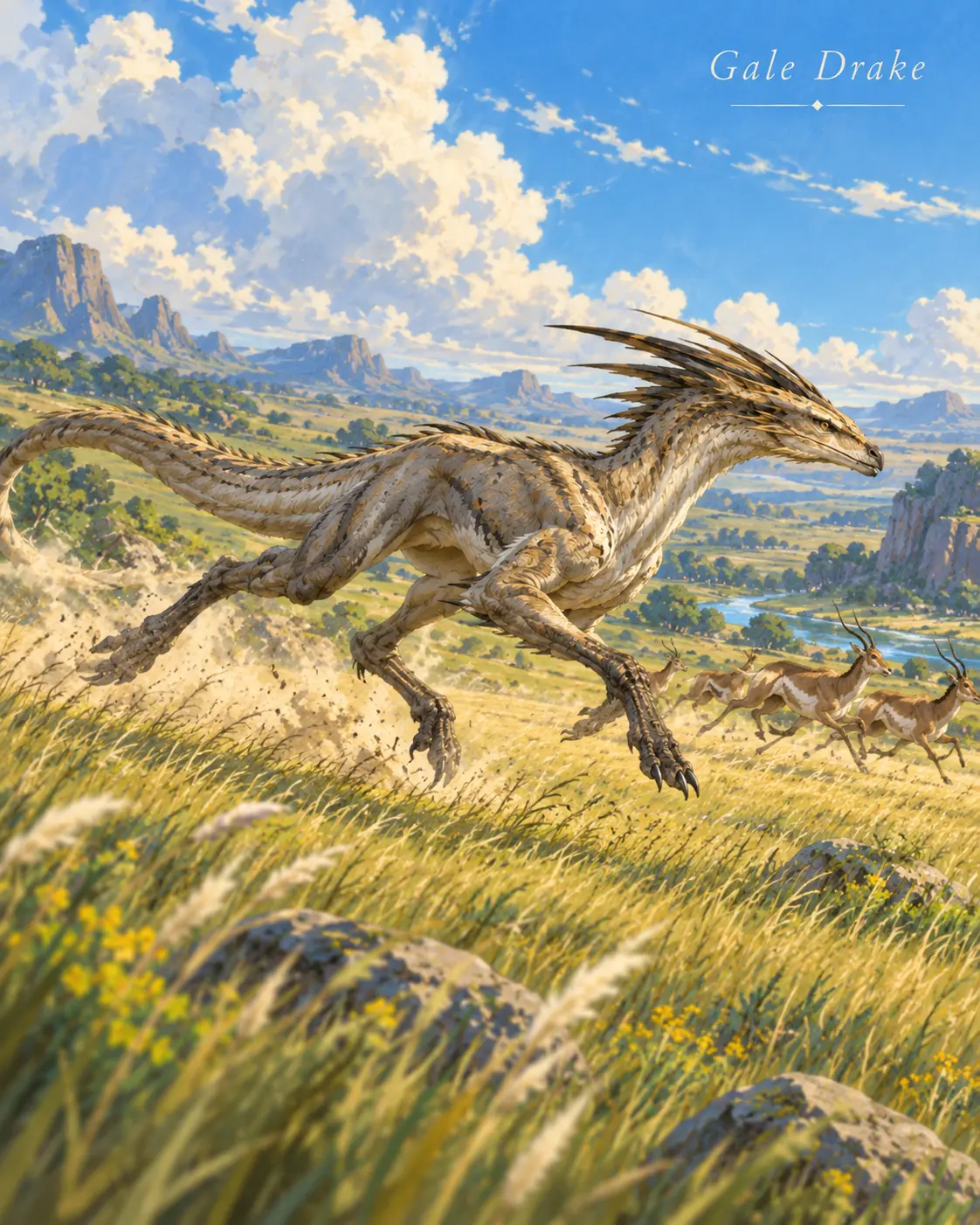
Long-legged aerodynamic endurance hunter; powerful wind-assisted turns and sprinting; remains wingless and terrestrial.
Encounter Threat B-class level threat
Habitat: Open eastern plains, steppe and grasslands.
Long-legged aerodynamic endurance hunter; powerful wind-assisted turns and sprinting; remains wingless and terrestrial.
Wingless natural magical apex fauna, with territories and biological resource limits. Signs, territory mapping and route choices can prevent detection. Once people are detected, the wild drake becomes a lethal threat; protecting travelers and investigating displacement require that danger to be treated as real. Mature and ancient exceptional specimens differ; neither species identity nor an adventurer’s level determines a guaranteed outcome.
Field-guide plate estimates: 8–12 m; 1.5–3 tons; 3–4 m shoulder (on plate). These are illustrated estimates, not absolute species-wide limits.
Mature adult baseline: B — Severe. Ancient exceptional individuals may be A — Extreme; this is not a blanket rating for juveniles or every encounter.
Wild or unbound members of this lineage are lethally hostile to people on meaningful detection. Established bonded, domesticated, Companioner-trained or canonically socialized individuals are exceptions. Ecology and intelligence do not erase the wild baseline.
Tracking Info
Long-stride prints form astonishingly straight travel lines over open country. Turn zones show sweeping skid marks. Prey herds may suddenly bunch even when no predator is visible because of distant wind-carried scent.
Deeper Ethology
Gale Drakes are terrestrial endurance hunters. They use speed, wind-assisted turning, and long pursuit rather than concealment. They test herd edges, pressure weaker animals, and avoid unnecessary collision. Young animals overcommit turns; old individuals learn wind corridors and terrain funnels. Wild, unbound Mana Beasts are lethally hostile to people upon meaningful detection. Ambush, flanking, pursuit and attack timing follow the species’ established senses and tactics. Early warning and staying beyond detection can prevent contact; once detected, survival requires force, earned deterrence, specialized established abilities or escape. Ordinary distraction or handling does not make the creature safe.
When This Is Wrong
A break from these patterns is a reason to investigate. Injury, hunger, breeding, severe weather, migration, displacement, disease, mana instability or learned responses to people can change behavior. Observe the context before deciding what the sign means.
Approved visual canon
Approved art archive
Each image is paired with this record so its identity and context remain attached wherever it appears.
Connected world
Follow the relationships
Each connection opens the matching canonical record or a focused Codex search when that subject does not yet have its own public record.